Carbonic Acid vs. Sulfuric Acid for Water pH Control
Every gallon you acidify with sulfuric acid deposits sulfate that never leaves. A 200-acre pistachio operation irrigating 3 acre-feet per year adds roughly 300 to 500 lbs of sulfate to its soil, every year. Carbonic acid reaches the same target pH and leaves nothing behind.
What Does the Soil Data Show?
One pistachio orchard in the Central Valley, one season. One block on sulfuric acid, one on ECO2MIX carbonic acid. Same crop, same water, same weather. Haney soil tests on both:
| Haney soil measure | Sulfuric acid block | ECO2MIX block |
|---|---|---|
| CO₂ respiration | −16% | +69% |
| Microbial diversity | −13% | +12% |
| Soil organic matter | −4% | +124% |
| Total organic carbon | 116 to 107 ppm | 113 to 264 ppm |
The only variable was the acid.
Why Does That Happen?
Sulfuric acid dissociates completely in water:
H₂SO₄ + 2HCO₃⁻ → SO₄²⁻ + 2CO₂ + 2H₂O
The sulfate ion (SO₄²⁻) stays in the soil permanently, raising EC and salt load with every irrigation.
Carbonic acid forms a reversible equilibrium:
CO₂ + H₂O ⇌ H₂CO₃ ⇌ H⁺ + HCO₃⁻
After irrigation it breaks back into CO₂ gas and water. No sulfate, no chloride. The CO₂ feeds soil microbes and stimulates glomalin production, the soil-binding protein made by mycorrhizal fungi.
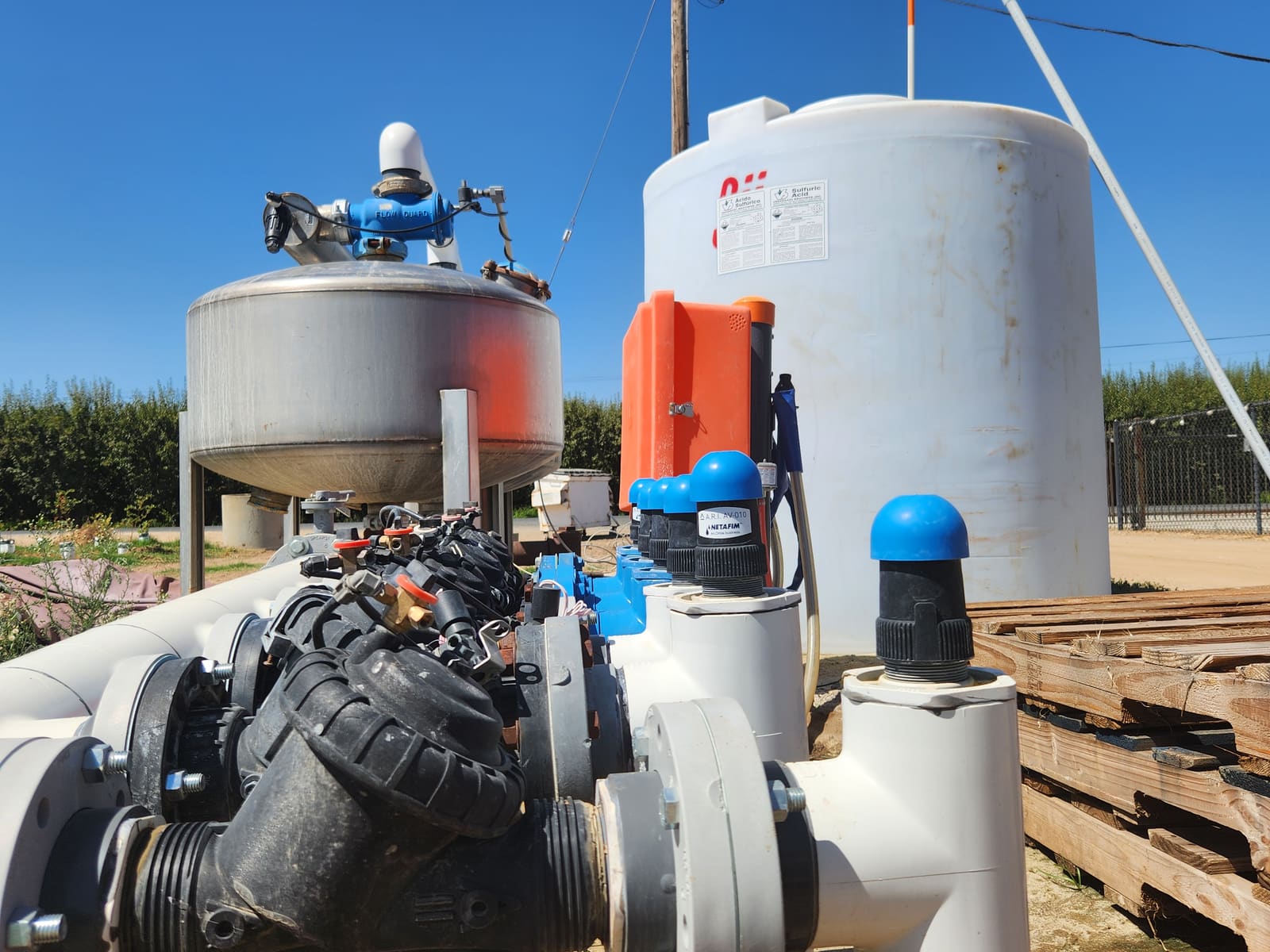
Sulfuric acid storage at a typical pump station.
What About Safety?
Sulfuric acid at 98% is a Class I hazardous material: secondary containment, spill protocols, full PPE, and immediate washing on any skin contact.
Carbonic acid uses CO₂, the same gas in a soda machine. No hazmat storage, no PPE, no corrosion risk.
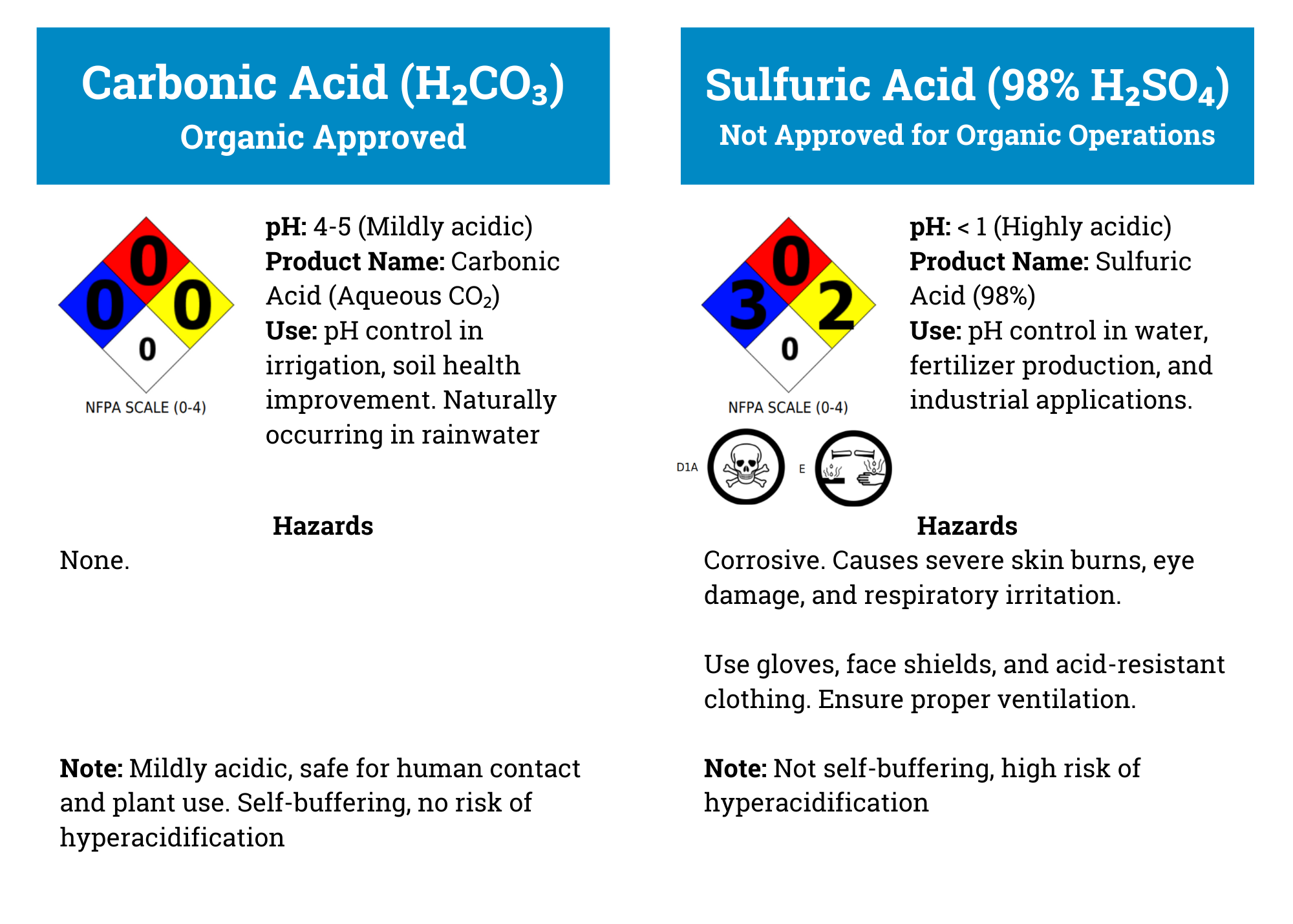
The two Safety Data Sheets, side by side.
Sulfuric acid is not permitted in certified organic agriculture. ECO2MIX carbonic acid is CCOF approved, and pending NOSB approval for the USDA National List of Allowed Substances. Running organic and comparing against sulfur burners? See the dedicated comparison.
“We're able to see a reduction in inputs that we're having to sell the grower because we're improving the soil. The microbial health improvement is huge.”

The Full Side-by-Side
| Factor | Sulfuric Acid | Carbonic Acid (ECO2MIX) |
|---|---|---|
| Reaches target pH | Yes, fixed injection rate | Yes, probe-driven on every cycle |
| Left in the soil | Sulfate, adds to EC and salt load | Nothing. CO₂ and water |
| Over-acidification risk | Yes, narrow margin for error | None. Self-limits near pH 5.0 |
| Soil biology | Suppressed over time | Improves. CO₂ feeds microbes |
| Soil EC | Rises as sulfate accumulates | Neutral to decreasing |
| Safety | Hazmat storage, PPE, burn risk | Beverage-grade CO₂, no PPE |
| Organic certification | Not permitted | CCOF approved, NOSB pending |
| Equipment corrosion | Corrodes pipes and fittings | None at ag and turf targets |
| Cost model | Capital purchase, plus acid and maintenance | One fixed-price service, everything included |
Common Questions
Can sulfuric acid cause hyper-acidification?
Is carbonic acid approved for organic operations?
Why does sulfuric acid create injection distribution challenges?
See It Discussed in the Field
Growers and PCAs at a Nutrien field day in Selma saw the two acids side by side: what each one does to the water, what each leaves in the soil, and how the handling differs on a working pump station.
Ready to Move Away from Sulfuric Acid?
A fully managed service: system, CO₂, calibration, and remote monitoring included. No upfront equipment cost, no hazmat on the farm.