Carbonic Acid and Bicarbonates in Irrigation Water
Bicarbonates are invisible on the leaf and invisible on the soil test, but they are doing damage in the water line and at the wetting front every time you irrigate.
| High-Bicarbonate Water, Untreated | With Carbonic Acid |
|---|---|
| Water arrives at pH 7.8 to 8.2; nutrients lock out | Water arrives at pH 6.5; nutrients stay soluble |
| Scale forming in emitters; uniformity declining | Scale stops forming; emitters stay clear |
| Phosphorus, iron, zinc tied up | Phosphorus, iron, zinc available at the root zone |
| Soil pH creeping up every season | No sulfate, chloride, or ion residue added |
| Calcium locked as CaCO₃, unavailable | CO₂ dissolves CaCO₃; calcium plant-available |
The mechanism is carbonate speciation: at pH 6.5, roughly half of all bicarbonate converts to carbonic acid, which breaks back into CO₂ and water.
How Does Carbonic Acid Reduce Bicarbonates?
Carbonic acid forms when CO₂ dissolves in water:
CO₂ + H₂O ⇌ H₂CO₃ ⇌ H⁺ + HCO₃⁻
The form carbon takes depends on pH. Saruhashi (1955) published the defining tables: at pH 8.0, about 98% of dissolved carbon is bicarbonate. At pH 6.3 the two forms are equal. Target pH 6.5 and roughly half of all bicarbonate has become carbonic acid.
| Condition | Result |
|---|---|
| At pH 6.3 | H₂CO₃ = HCO₃⁻ (Saruhashi crossover) |
| At pH 6.5 target | ~50% of bicarbonate converted to carbonic acid |
| Alkalinity change from adding CO₂ | Zero (Wolf-Gladrow et al., 2007) |
Lowering water from pH 8.0 to 6.5 converts existing bicarbonate. Nothing new is added, and alkalinity does not change.
How Does CO2 Free Up Calcium?
CO₂ in treated water reacts with calcium carbonate (lime) in the soil:
CaCO₃ + CO₂ + H₂O ⇌ Ca²⁺ + 2HCO₃⁻
Solid lime the plant cannot use becomes dissolved calcium it can. The liberated bicarbonate is mobile and leaches through the profile instead of accumulating at the root zone.
Is Your Water a Problem? Check the Report.
- pH: above 7.5 is a concern; above 8.0 is significant
- Bicarbonate (HCO₃⁻): above 120 mg/L is a concern; above 180 mg/L is high
- Alkalinity as CaCO₃: above 150 mg/L for turf, above 200 mg/L for most crops, warrants treatment
- SAR: elevated SAR plus high bicarbonate accelerates sodium hazard
- RSC: positive RSC means the water will deposit carbonates in the soil
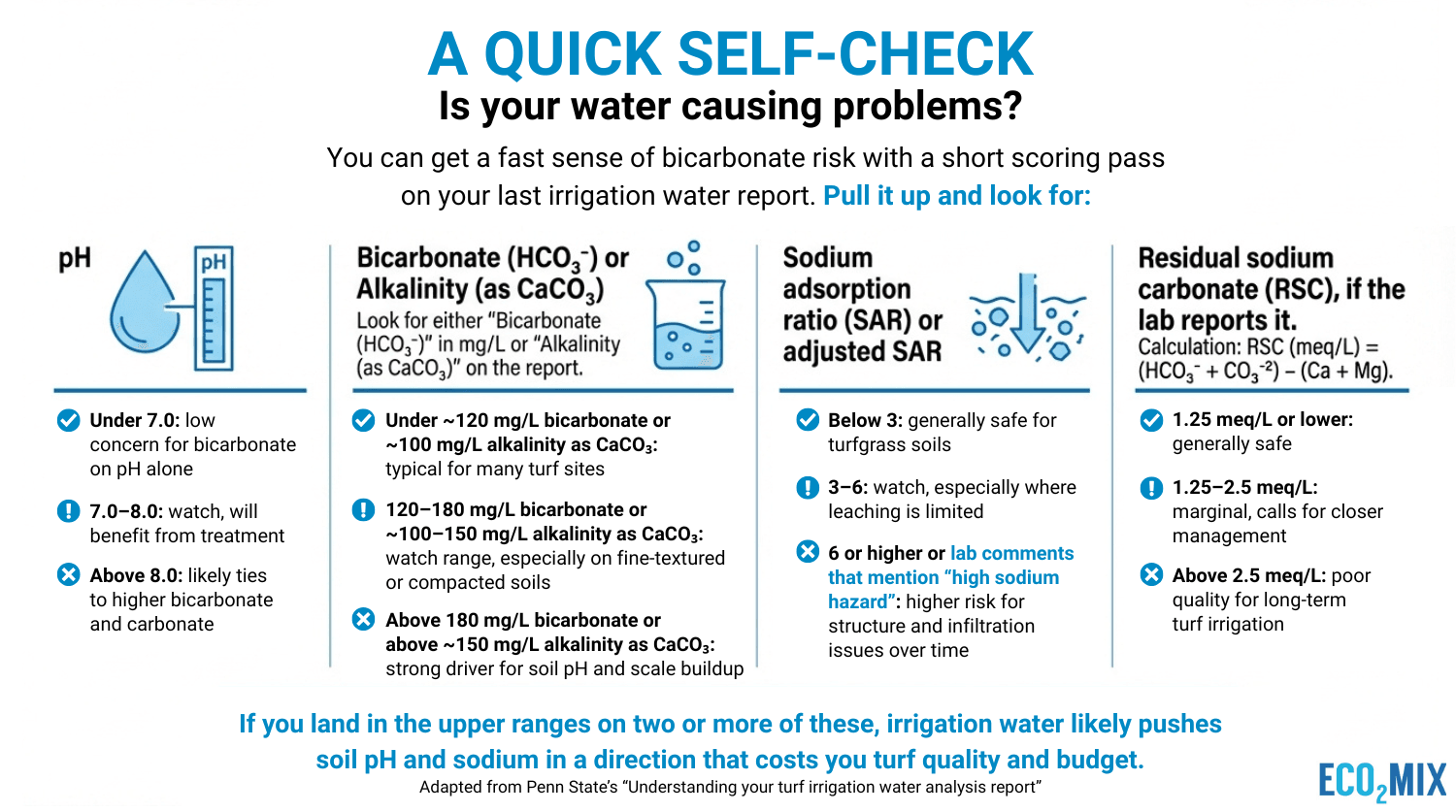
The same numbers, as a quick field reference.
What Does the Research Show?
Lampreave et al. (2022) irrigated calcareous vineyards with carbonated water at roughly pH 6.5. Phosphorus, iron, manganese, zinc, and calcium availability all rose in leaf tissue, leaf iron nearly doubled, and yield increased 30 to 42% per vine by year three. ECO2MIX field sampling shows declining soil EC on treated farms: no salt ions are added, and better infiltration helps existing salts leach.
“We're able to see a reduction in inputs that we're having to sell the grower because we're improving the soil. The microbial health improvement is huge.”

Common Questions
Does carbonic acid raise bicarbonates in irrigation water?
Is carbonic acid effective even though it is a weak acid?
What happens to carbonic acid in the soil after irrigation?
See the Chemistry Explained
Questions About Your Water pH?
A fully managed carbonic acid service: system, CO₂, calibration, and monitoring included. No upfront equipment cost.