Black Layer on Golf Greens
Black layer is a dark, greasy, rotten-egg band a few centimeters down in the rootzone. It means the soil has gone anaerobic. Acidifying the irrigation water will not repair drainage, but on high-bicarbonate and reclaimed sources it removes one of the levers keeping the profile wet, and it is the one lever a superintendent can move every single day.
What Is Black Layer?
Black layer is an oxygen-poor zone that forms just below the surface, most often on sand-based greens. When you pull a core, the signs are consistent: a dark gray or black band, a slimy feel, a rotten egg odor from hydrogen sulfide, and weak, shallow roots sitting on top of it. Sulfate-reducing bacteria produce the hydrogen sulfide, which reacts with iron and other metals to form the black sulfides you see.
A Quick Field Check
Walk a green, pull a plug where the turf looks weakest, and rule black layer in or out on the spot. Save and print the checklist so it is on hand.
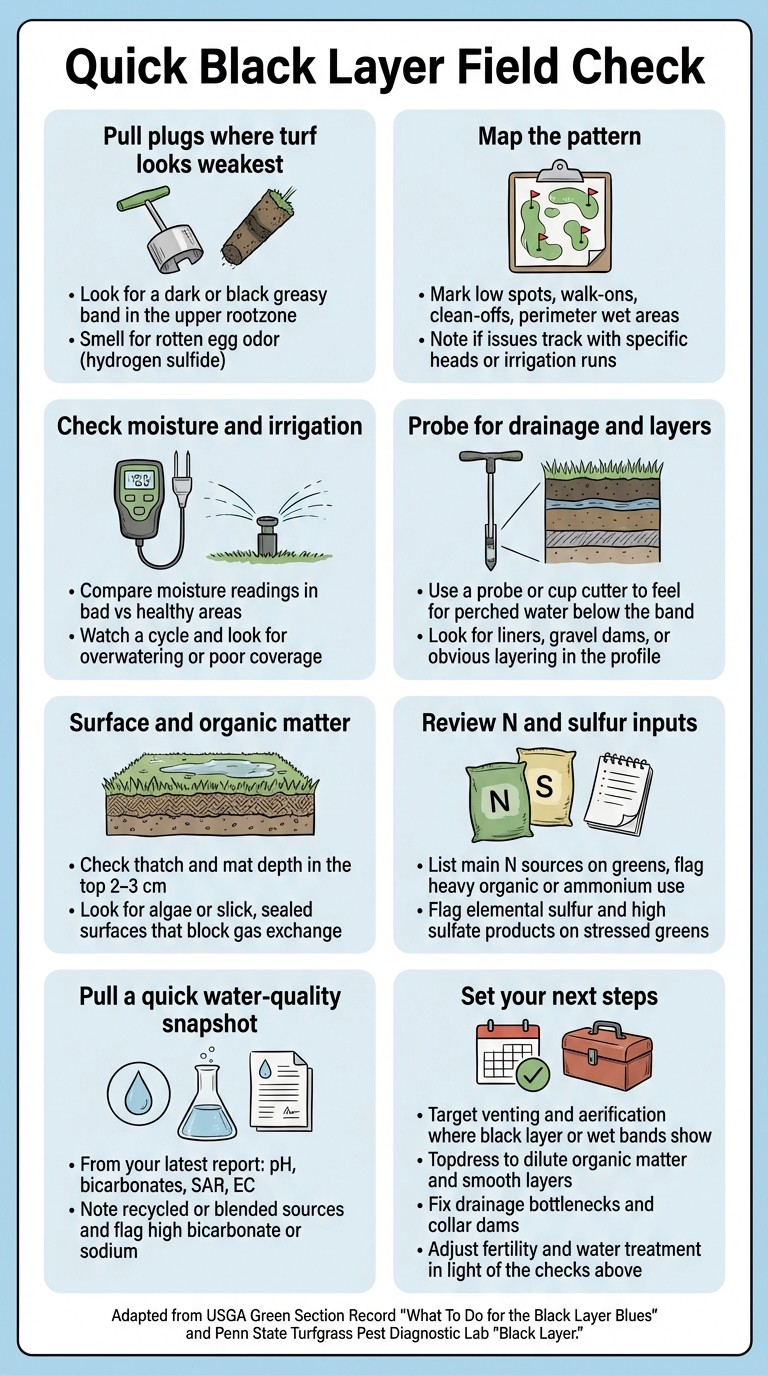
Adapted from USGA Green Section Record and the Penn State Turfgrass Pest Diagnostic Lab.
What Causes It?
At its core, black layer shows that the rootzone ran short on oxygen. Several factors usually stack up at once:
- Chronic wetness and layering. Low spots, tired drainage, and fine material in the upper profile keep water sitting in the same band.
- Compaction and heavy play. Traffic closes pore space and traps water, especially at walk-ons and clean-off areas.
- Excess organic matter and algae. Thatch holds water; surface biofilms seal the top and limit gas exchange.
- Irrigation water quality. High bicarbonates and sodium tie up calcium, encourage carbonate scale, disperse fine particles, and slow infiltration, so the upper rootzone stays wetter after every cycle.
High pH in the soil solution also locks out iron, manganese, and phosphorus, so stressed, shallow-rooted turf sits on a profile that already struggles to move water and air. For the underlying chemistry, see Carbonic Acid and Bicarbonates.
Where Water pH Control Fits
Superintendents on high-alkalinity or reclaimed water often inject acid to lower pH and neutralize bicarbonates. That improves infiltration and helps the surface reset each cycle. The catch is that acidified water still runs through the same profile: if drainage, layering, and compaction remain, the rootzone can slip back into oxygen-poor conditions even when the water test looks better. Water pH control is one lever in the program, not a replacement for aeration and drainage.
Which acid you use changes what you leave behind.
| Sulfuric or blended acid | Carbonic acid |
|---|---|
| Adds sulfate with every gallon; salt load can build in a slow-draining profile | Adds no sulfate or chloride; nothing accumulates in the rootzone |
| Bulk storage and handling of a strong mineral acid | CO₂ system, no acid stored on property |
| Corrosion risk on pumps, fittings, and heads | Non-corrosive to the irrigation system |
| Lowers pH and neutralizes bicarbonates | Lowers pH and neutralizes bicarbonates, and adds CO₂ that feeds soil biology |
Carbonic acid corrects the water the same way on the chemistry side, then equilibrates with the soil atmosphere rather than leaving a pool of strong mineral acid. On reclaimed and high-alkalinity sources, avoiding the extra sulfate and salt load is the difference that matters.
Prevention That Holds
Preventing black layer means protecting oxygen in the rootzone and managing both the profile and the water that runs through it:
- Vent and aerify on a schedule matched to traffic and climate.
- Topdress with light sand to dilute organic matter and avoid layering.
- Keep water moving off low collars and perimeter areas.
- Manage moisture tightly with meters and hand watering, not set and forget.
- Acidify high-bicarbonate water to hold infiltration, without adding a new salt to the profile.
Systems like ECO2MIX apply water pH control at the pump station, so water reaches the course with a corrected pH, a lower bicarbonate load, and no added sulfate.
Common Questions
Can irrigation water cause black layer?
Does acidifying the water fix black layer on its own?
Why choose carbonic acid over sulfuric acid for black layer?
How fast will I see a difference after treating the water?
High-Bicarbonate Water on Your Course?
Tell us your water source and pump station setup. We size the system and send a fixed-price proposal for your course. No obligation.