On This Page
Irrigation water at an electrical conductivity of 2 dS/m carries about 1.7 tons of dissolved salt in every acre-foot. Put 30 inches on a block over a season and you have delivered about 4.4 tons of salt to every acre of it, which is roughly the weight of two full-size pickup trucks parked on each acre, every year. On a hundred acre planting that is 440 tons. Those figures are from Utah State University Extension, and that water is not unusual.
Nobody loads that on a truck. It comes in dissolved, a few hours at a time, in water that looks clean and tests fine. Calcium, sodium, magnesium, sulfate, chloride, carbonate and bicarbonate are all in there. So is boron, and boron does its damage at concentrations that look like nothing on a report.
Then the water leaves. The surface evaporates it, and roots take up far more water than salt, which is why the solution they leave behind gets saltier. Plants do take up some of these ions and several of them are nutrients, but uptake is not how a field gets rid of salt. Salt accumulation under drip irrigation is not a sign that something has gone wrong. It is the arithmetic of irrigating at all.
What is worth knowing is where in the field that salt ends up, because it does not spread evenly and the worst of it is not where most people look for it. This article covers where salt collects under a drip system, why a small rain can do more damage than no rain at all, and which number on your water report tells you how that salt will behave once it is in the ground.
Quick questions and answers
Why is there a white crust at the edge of my drip line?
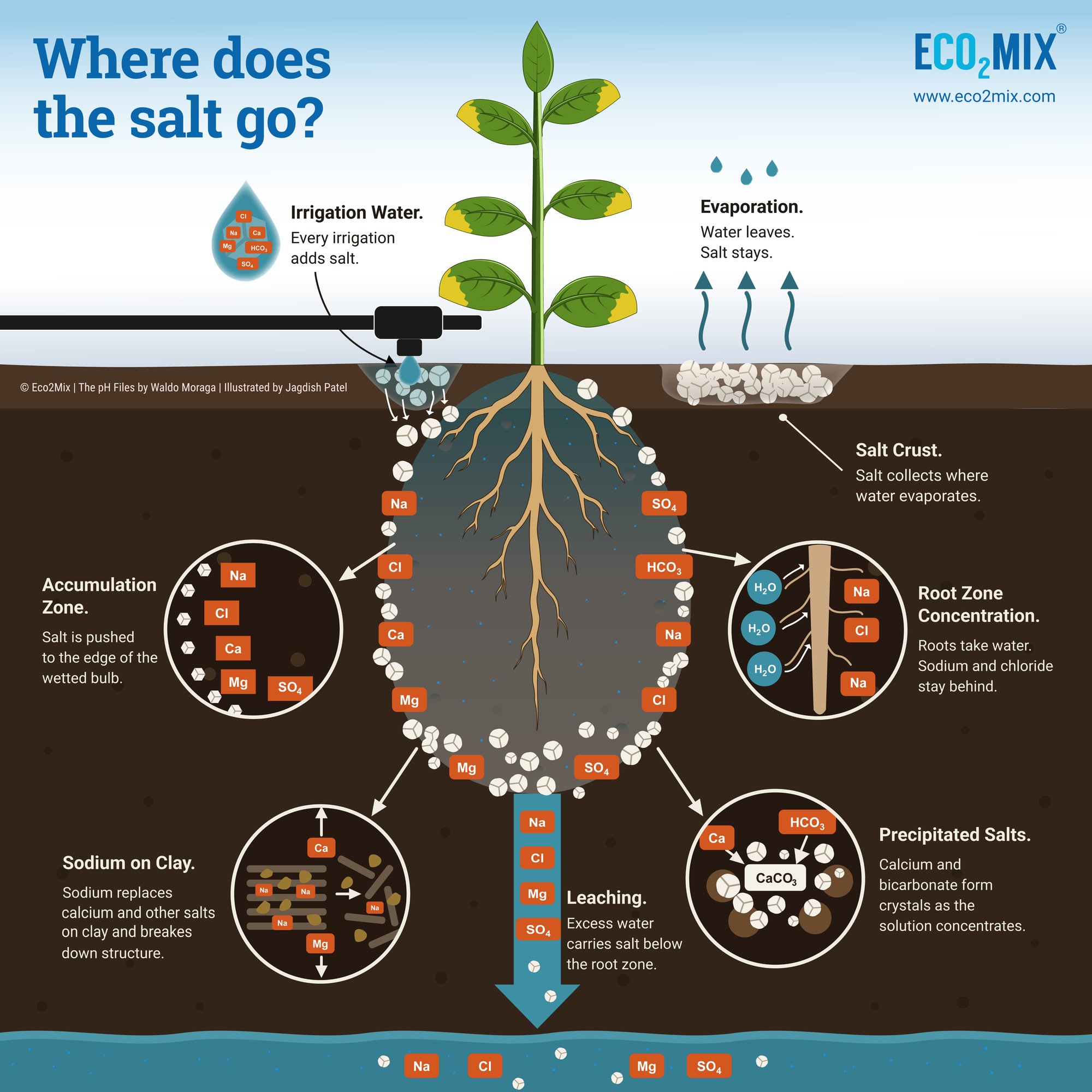
That crust is salt, and the edge of the wet soil is where it ends up. The water stops there, so the salt stops there. The soil directly under the emitter is the cleanest in the field.
Does a small rain make salt damage worse?
It can. Anything under about an inch dissolves the salt at the surface and moves it toward the roots instead of past them. The University of California rule of thumb for avocado is a good one inch rain, or two inches of combined events in a short period, to clear the top 18 inches.
Do plants remove salt from the soil?
Not in any amount that matters. Roots take up some ions, and sodium, chloride and boron can build up in leaves to the point of visible damage, but that is damage, not removal. Leaching is the only effective way to get salt out of soil.
Can salt be removed from irrigation water?
Not by chemical treatment. Separating salt from water takes desalination, which is rarely practical at field scale. What treatment can change is the form the salts are in, and the form decides how they behave once the water is in the soil.
The clean zone and the salt ring
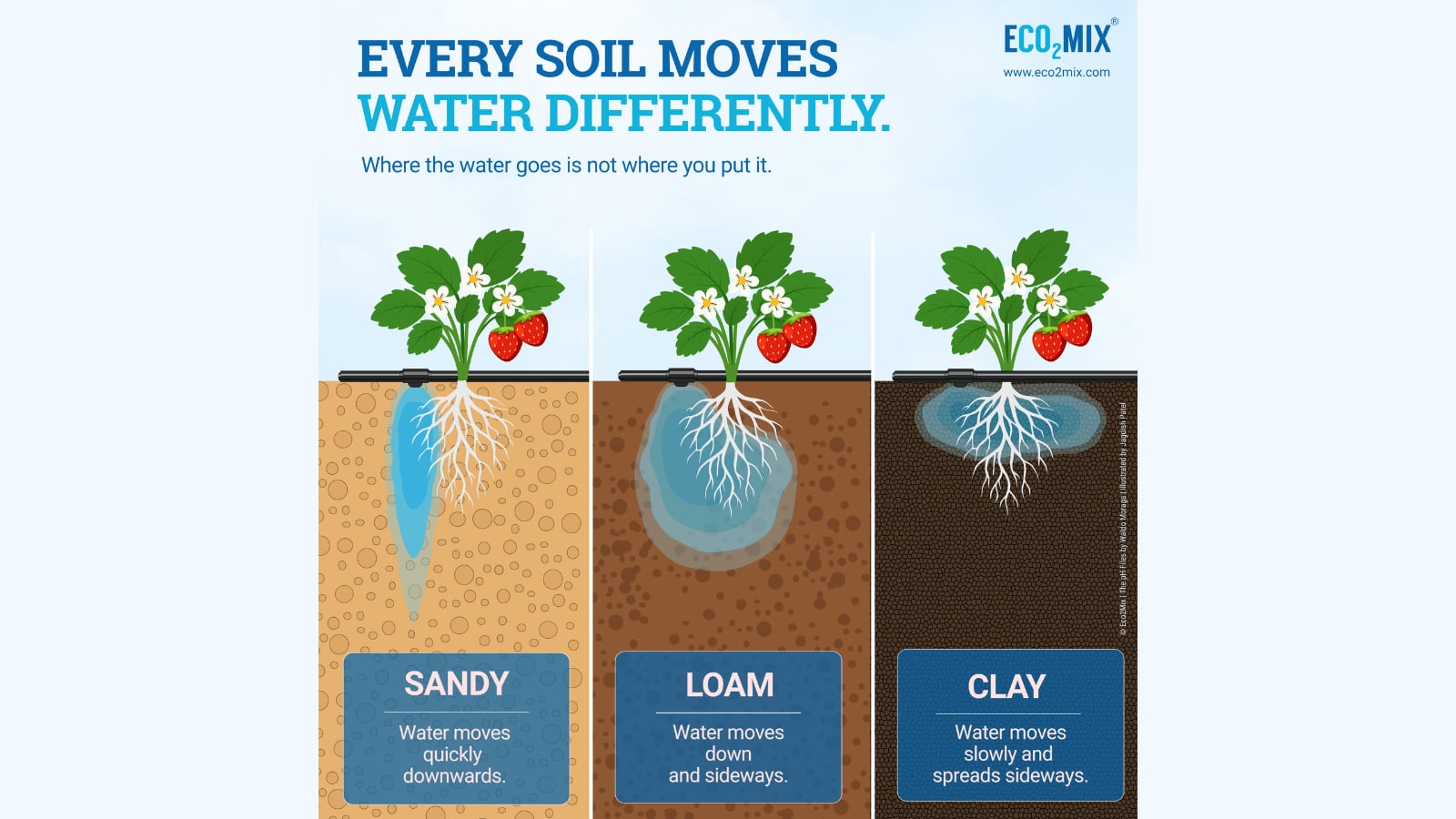
Under an emitter the salt does not spread evenly. Water leaves the emitter and moves out into the soil, and the shape it makes, the drip irrigation wetting pattern, is decided by the soil texture. The salt goes wherever that water goes, so the soil closest to the emitter gets rinsed at every irrigation while the salt is pushed toward the outside of the wet zone.
That is what salt accumulation under drip irrigation actually looks like, and it leaves two zones that look identical from a tractor seat. Directly under the line the soil is the cleanest in the field. At the outer edge of the wet soil, and in the dry strip between emitters, the salt collects and stays.
Hanson and May (2011) mapped this in California row crops and found that soil salinity increases with distance from the emitter, so the largest values turn up near the edge of the wetted pattern. They also found that the low salinity zone gets bigger when more water is applied, because the extra water carries the salt further out before it stops.
Where the salt stops moving
Salt travels as far as the water carries it and no further. Anything that stops the water stops the salt in the same place.
A change in soil texture does this. Zhang and colleagues (2014) followed salt through a cotton field in northwestern China for three years, taking more than 15,000 soil samples. The soil directly below the drip line ended up with the lowest salinity in the field, while salt collected above the finer soil layers, where the downward movement slowed. If your profile has a hardpan or a texture change at two feet, that boundary is collecting salt as well as holding water.
The surface does the same thing in the other direction. In the dry soil between emitters, water creeps up toward the surface and evaporates there. The water leaves as vapor, the salt cannot follow it, and it builds in the top few inches of the one part of the field that never gets rinsed.
A small rain can make it worse
This one catches people out, and it follows from everything above.
Salt in the surface soil goes wherever the next water pushes it. A heavy rain carries it down past the roots. A light rain does not. It has enough water to dissolve the salt at the surface and move it a few inches, which is exactly where the roots are working, and not enough to carry it through and out.
Faber (2016), writing for University of California Cooperative Extension, describes avocado blocks showing leaf damage within a week of a rain that was not big enough to leach. The UC rule of thumb for that crop is that it takes a good one inch rain, or two inches of combined events in a short period, to move the salt out of the top 18 inches. Below that, the salt moves sideways toward the roots rather than down past them.
So a field can come through a dry stretch looking fine and then show salt stress after the first small rain of the season. Nothing new arrived. The salt that was already there moved into the root zone.
Why salt accumulation under drip irrigation stacks up in a permanent crop
A row crop gets replanted and the beds get reworked, so the salt distribution is disturbed every season. An orchard or a vineyard is not. The emitter stays where it is for twenty years and wets the same soil every time.
Nightingale and colleagues (1991) measured how soil salinity was distributed across an almond orchard at different trickle irrigation rates. In a permanent planting that distribution is not a one season result. The same shape gets rebuilt at every irrigation, in the same place, for the life of the block.
The roots make it more pointed. Roots grow where the water is, so they concentrate in the clean soil under the emitter, which is the smallest part of the wetted volume. The tree ends up feeding from a narrow column with a salt ring around the edge of it.
Salt only leaves one way
There is no chemistry that destroys salt. It is not consumed, broken down or used up. Once it is in your soil the only way out is dissolved in water that moves below the root zone and drains away.
In California and in every other dry irrigated region, winter rain is doing that job. In a wet year it works. In a dry year the salt that arrived over the season is still there when the next season starts, and it adds to whatever was left from the year before.
The number on your water report that is easy to miss
Most people look at the salinity figure on a water test, the EC, and stop there. That number tells you how much salt is arriving. It does not tell you how that salt will behave once it is in the ground.
Sodium is the one that damages the soil rather than just stressing the crop. Sodium on clay particles makes them swell and separate, which closes up the spaces between them, and a soil that has lost its structure will not take water in at the rate it used to. The sodium adsorption ratio on your report is meant to warn you about that, by weighing sodium against the calcium and magnesium that hold structure together.
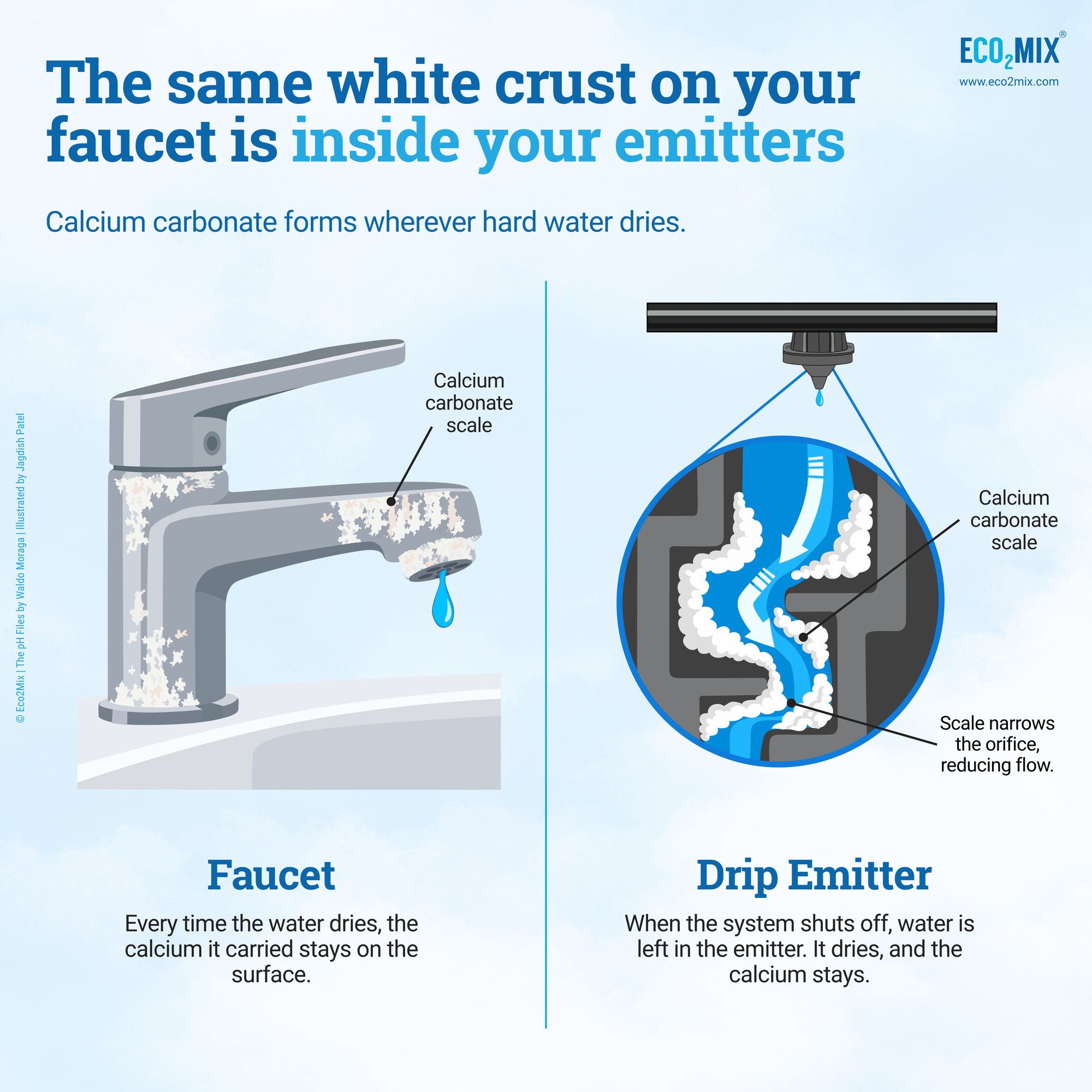
Here is the part that is easy to miss. Ayers and Westcot (1985), the standard reference on irrigation water quality, describe what happens when water carries a lot of bicarbonate. As the soil solution concentrates between irrigations, the bicarbonate and the calcium come out of solution together as calcium carbonate, the same white scale that forms on a faucet. That calcium is no longer available to counter the sodium. The sodium has not increased, but its share has, and the real sodium hazard is higher than the plain ratio on the report suggests.
Two waters with the same salinity figure can leave a soil in very different condition after ten years, depending on how much bicarbonate each of them was carrying.
The soil you have and the water you choose
Where your soil puts the salt is not something you can change. The texture decides where the water goes, the water decides where the salt goes with it, and both of those are settled before you turn the pump on.
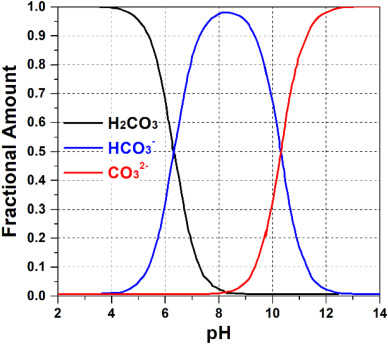
What the water carries is the part that is open to change. You cannot take the salt out of irrigation water in the line, but you can change the form it arrives in, and the form decides how it behaves once it is in the ground. ECO2MIX injects carbon dioxide into the water, where it forms carbonic acid and converts part of the bicarbonate before the water reaches the field. With less bicarbonate arriving, less calcium is pulled out as carbonate while the soil solution concentrates between irrigations, and the calcium that stays in solution is still available to hold clay structure against sodium. A soil that keeps its structure keeps taking water in, and taking water in is what makes leaching possible at all.
This is worth being exact about, because no treatment removes salt. Sulfuric acid, the long-standing way of handling high bicarbonate water, does not remove it either. The acid destroys the bicarbonate, which leaves as carbon dioxide gas, and in its place it puts sulfate, which stays. One anion is traded for another. Carbon dioxide injection adds no ion at all. What it changes is the form the carbonate is in while the water is being delivered, and the pH effect it produces in the soil is brief and local to the wetted zone. It does not change where the water goes or the shape of that zone. The texture decided those.
References
Ayers, R.S., and Westcot, D.W. 1985. Water quality for agriculture. FAO Irrigation and Drainage Paper 29, Rev. 1. Food and Agriculture Organization of the United Nations, Rome.
Faber, B.A. 2016. A little rain can cause salt problems. Topics in Subtropics, University of California Agriculture and Natural Resources, October 25, 2016.
Hanson, B.R., and May, D.M. 2011. Drip irrigation salinity management for row crops. University of California Agriculture and Natural Resources, Publication 8447.
Nightingale, H.I., Hoffman, G.J., Rolston, D.E., and Biggar, J.W. 1991. Trickle irrigation rates and soil salinity distribution in an almond (Prunus amygdalus) orchard. Agricultural Water Management 19(3): 271-283.
University of California Agriculture and Natural Resources. O no, it’s raining. Topics in Subtropics.
Utah State University Extension. Managing saline and sodic soils and irrigation water. Utah State University, Logan, Utah.
Zhang, Z., Hu, H., Tian, F., Hu, H., Yao, X., and Zhong, R. 2014. Soil salt distribution under mulched drip irrigation in an arid area of northwestern China. Journal of Arid Environments 104: 23-33.
This article is part of The pH Files series from ECO2MIX. Illustration by Jagdish Patel, Soil Stories.

Was this article helpful?
Thanks for your feedback!
Better Water pH for Your Crops
Get a Proposal