On This Page
You have probably noticed this in your own field. Some plants ask for water before the others do. Same line, same emitters, same run time, but a few start wilting while the rest still look fine.
A drip emitter puts water on one precise spot, and that precision ends at the soil surface. Below it, the soil takes over. The drip irrigation wetting pattern it creates decides how much of the root zone gets wet, and it is not the same in every part of a field. A system can put on exactly the right number of inches and still deliver them to the wrong place.
What decides the drip irrigation wetting pattern
Start with what the soil is made of. Every soil is a mix of three particle sizes: sand, silt and clay. Sand grains are the biggest, and you can feel them between your fingers. Clay particles are the smallest, far too small to see. Silt falls in between.
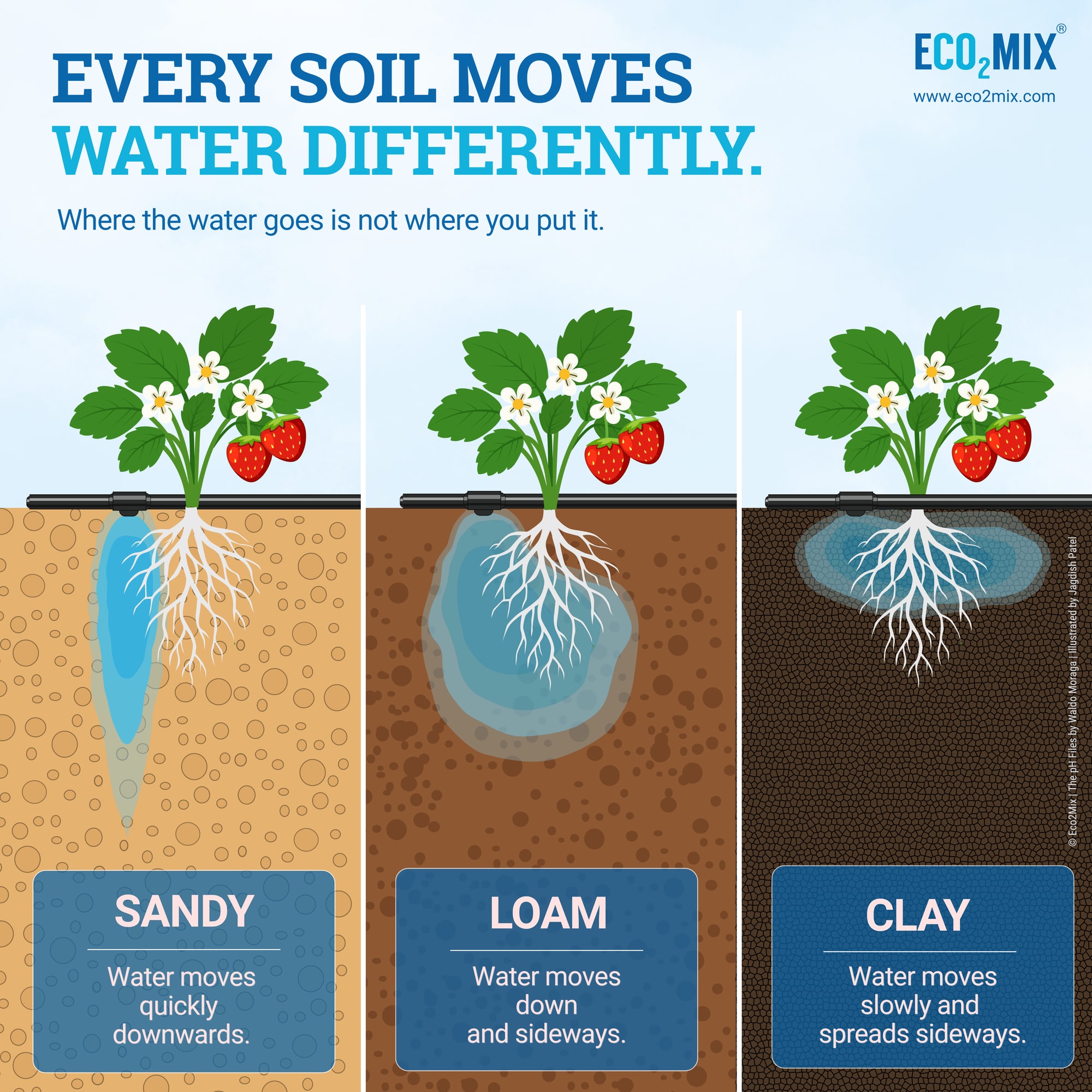
No soil is only one of the three. What we call a sandy soil or a clay soil is a mix where one of them has the upper hand. When all three are present in fairly even amounts, the soil is called a loam, the middle panel in the illustration above. Change those proportions and you change the size of the spaces between particles, and those spaces decide everything that follows.
Water leaving an emitter gets pulled two ways at once. Gravity pulls it straight down. The soil itself pulls it sideways and outward, because water clings to particle surfaces and creeps into the smallest spaces it can find. Soil scientists call that second pull matric potential. Whichever pull is stronger decides the shape of the wet zone.
Sand, loam and clay under the same emitter
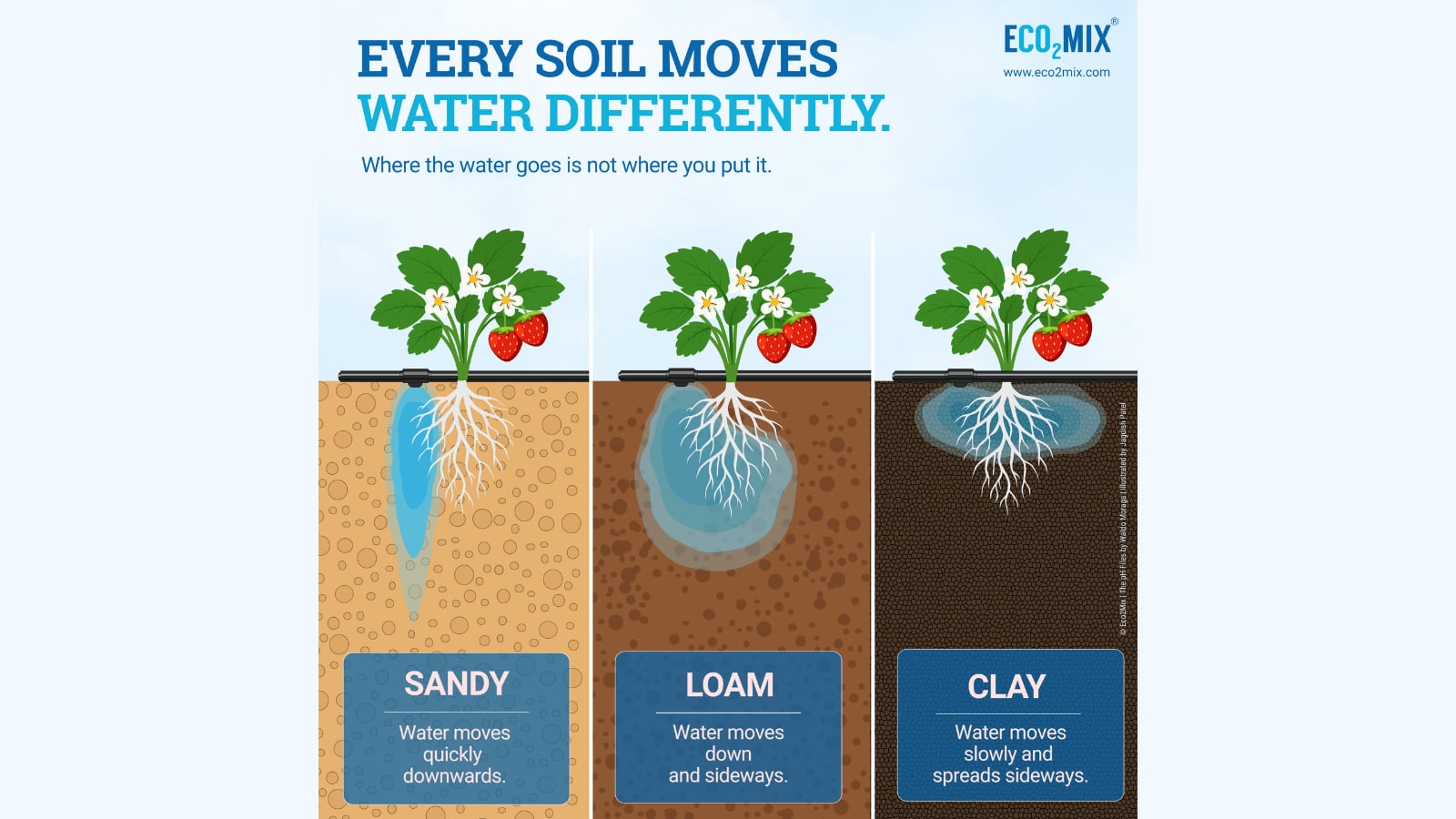
Put the same emitter, the same water and the same run time on all three soils and you get three different shapes underground.
Sandy soil has wide spaces, so gravity wins. Water goes almost straight down in a narrow column and barely spreads out. One emitter wets a small patch of ground. As long as the water is running that column keeps getting deeper, so a long set carries water past the roots that are doing the work. Put the emitters far apart on sand and the columns never meet, and the soil between them stays dry.
In loam the three particle sizes are more balanced, so neither pull has it all its own way. Water moves down and outward at the same time and the wet zone comes out rounder, wider than in sand and deeper than in clay.
Clay has tiny spaces. The sideways pull is strong and the soil holds on to what it has, so the same volume of water spreads wide and shallow instead of going down. The trouble on clay comes from the other direction. Put water on faster than the soil can take it in and it runs across the surface, where the sun gets it before any root does. Keep clay wet too long and air cannot get in, and roots need air as much as they need water.
The drip irrigation wetting pattern also changes across a field, sometimes within a few rows. Two plants on the same line can be growing over two different shapes of wet soil, which is why they do not ask for water at the same time.
When the soil changes with depth
Very few soils are the same all the way down, and a change in the profile does more to your water than the texture at the surface does.
When the wetting front hits a boundary between two different soils, it stops and spreads. A fine layer over a coarse layer holds water above the join until enough pressure builds for it to enter the bigger spaces below. A coarse layer over a fine layer stalls the front because the soil underneath cannot take water as fast as it arrives. Cote et al. (2003) simulated buried emitters in layered soils and found that the layering changed both the distribution of water and the distribution of dissolved nutrients. A hardpan at two feet is doing as much to your water distribution as the topsoil is.
What the research measured
A 2003 study in Irrigation Science by Thorburn and colleagues worked out the size and shape of the wet zone for 29 different soils. Their starting point is the interesting part. Most drip systems get designed off one piece of soil information, which is whether the soil is called a sand, a loam or a clay. Two soils carrying the same name wet very differently.
Schwankl et al. (1999) followed a 22 acre almond orchard near Arbuckle on 3 to 4 feet of gravelly loamy sand over a clay layer, comparing surface drip, subsurface drip and microsprinklers. That coarse sand let almost no water move sideways away from the emitter. The microsprinkler trees, which wet more ground, yielded more and grew bigger trunks.
That is one orchard on one coarse soil, so it does not settle which system is better everywhere. The reason it happened is what carries across. On that soil, wetting more of the root zone grew better trees.
Where the roots actually are
The wet zone only matters where it meets roots. Every crop feeds from a shallower layer than its roots reach into. Almond roots go down about 6 feet, but most of the feeding happens in the top foot to three feet (Andreu et al. 1997).
On sand, a narrow front drops straight through that feeding layer in one long set, and the water below it is gone. On clay, a wide shallow zone leaves the deeper roots dry all season.
Roots grow where the water is. A small wet zone builds a small root system, and a small root system has less soil moisture in reserve when a heat wave arrives. Fine roots turn over constantly, but the volume of soil they occupy is set by where the water has gone in previous seasons. In a permanent planting that is settled years before the crop is mature.
What a soil test will not tell you
A soil test gives you a name for your ground, and that name is worth having. It is also the one piece of soil data most systems get designed from, and Thorburn et al. (2003) showed that soils with the same name do not wet the same way. Structure, compaction and where the layers change all have a say.
You can see the answer for yourself. Let an irrigation finish, give it a day, then dig a hole beside an emitter. Look at how wide the wet soil is, how deep it goes, and whether it has met the wet soil from the next emitter along. Do it when the field is in its normal condition, because a dry profile does not wet the same way as one irrigated all week.
That hole tells you more about the drip irrigation wetting pattern in that field than any number on a lab sheet.
The soil you have and the water you choose
Soil and water work together, and the difference between them is that you inherit one and choose the other. The texture of your ground is fixed, and it decides where every irrigation goes. What that water carries is the part you can change, and that is where ECO2MIX works, on the chemistry of the water rather than the path it takes through the soil. Both are worth knowing, because the same water behaves differently in sand than it does in clay. Irrigation water also carries dissolved salts, and salts do not evaporate, so the next article in the series follows the water to see where those salts end up.
References
Andreu, L., Hopmans, J.W., and Schwankl, L.J. 1997. Spatial and temporal distribution of soil water balance for a drip-irrigated almond tree. Agricultural Water Management 35: 123-146.
Cote, C.M., Bristow, K.L., Charlesworth, P.B., Cook, F.J., and Thorburn, P.J. 2003. Analysis of soil wetting and solute transport in subsurface trickle irrigation. Irrigation Science 22: 143-156.
Schwankl, L., Edstrom, J., Hopmans, J., Andreu, L., and Koumanov, K. 1999. Microsprinklers wet larger soil volume; boost almond yield, tree growth. California Agriculture 53(2): 39-43.
Thorburn, P.J., Cook, F.J., and Bristow, K.L. 2003. Soil-dependent wetting from trickle emitters: implications for system design and management. Irrigation Science 22(3): 121-127.
This article is part of The pH Files series from ECO2MIX. Illustration by Jagdish Patel, Soil Stories.
Was this article helpful?
Thanks for your feedback!

Better Water pH for Your Crops
Get a Proposal