On This Page
Iron is the fourth most abundant element in the earth’s crust, and most farm soils hold plenty of it. Yet an orchard can show yellow leaves with bright green veins every spring, even with all that iron underneath.
It looks like a simple shortage, so it gets treated like one. More iron goes on, as chelate or as a spray. The leaves green for a few weeks, and then the next round of growth comes out yellow again.
This is iron deficiency chlorosis. The tree is not short of iron. It is short of iron it can reach, and the reason is the ground it grows in: calcareous soil, and the bicarbonate that comes with it.
This article follows the iron from the soil to the leaf and shows where it gets stuck. It also covers why soil and leaf tests miss the problem, why iron fertilizer fades, and where irrigation water comes in. Quick answers to common questions are at the end.
How a root gets iron out of the soil
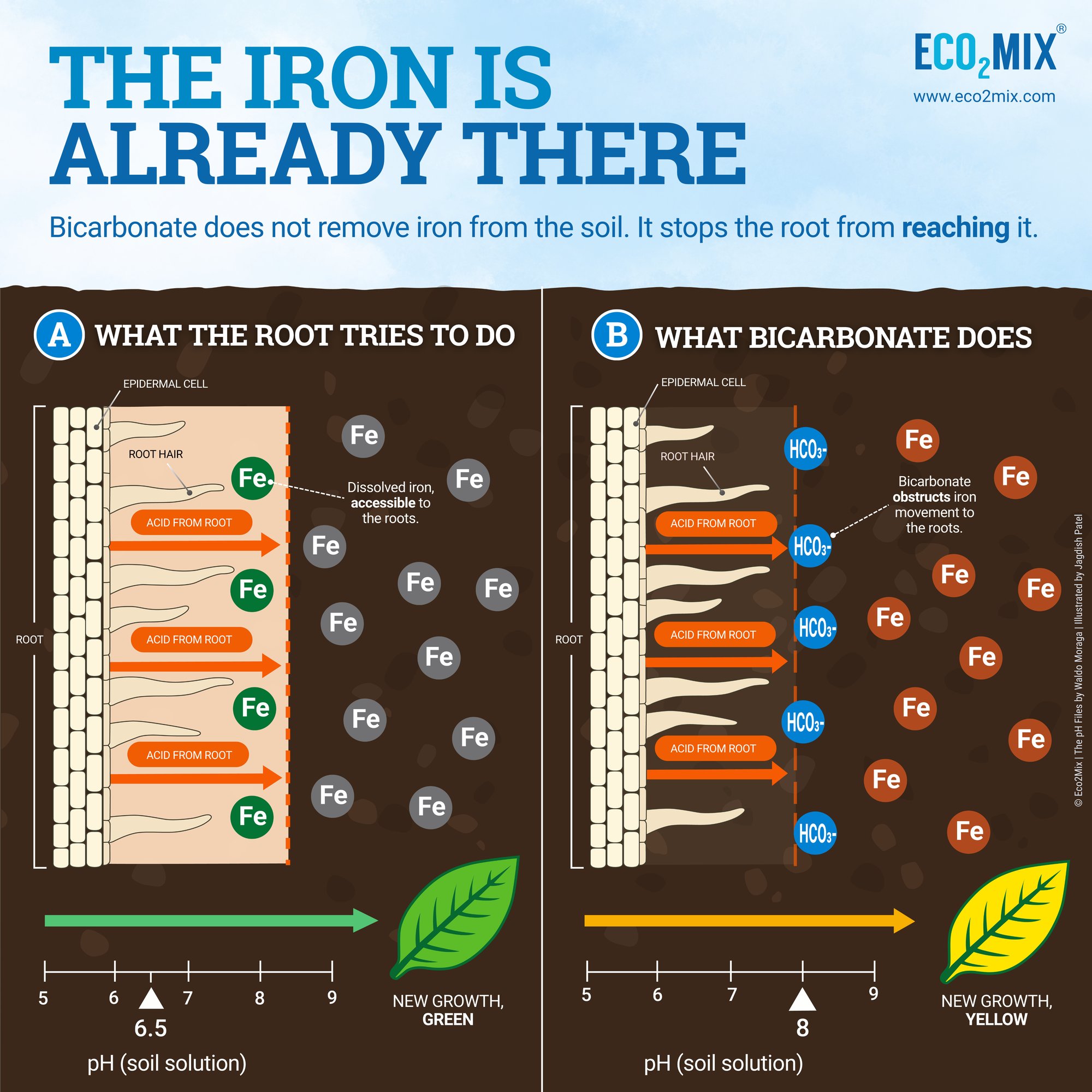
In most soils, iron is held as iron oxides, the compounds that give soil its red and brown colors. They barely dissolve, and pH controls how much they do. Fichtner and Elkins, writing for UC Cooperative Extension, note that the solubility of ferric iron rises about a thousandfold for every one unit drop in pH. Run it the other way: between pH 6.5 and pH 8.0, iron solubility falls more than 30,000 times.
Plants have a way around this. In most crops, the roots release protons at the surface and acidify a thin layer of soil around them. Iron dissolves in that acidified layer. An enzyme on the root surface then converts it from ferric to ferrous iron, and a transporter carries it into the root. Plant scientists call this Strategy I. Grasses use a different system, but almonds, citrus, avocados and grapes all rely on it.
The whole exchange happens within a few millimeters of the root. That layer is where an orchard either gets its iron or doesn’t.
What bicarbonate does to the root’s acid
A calcareous soil contains free lime, which is calcium carbonate, and the water moving through it carries bicarbonate. Bicarbonate is a buffer. When the root releases acid, bicarbonate neutralizes it. The root keeps pumping out protons and the soil around it stays alkaline. Because the lime is behind it, the problem is often called lime-induced chlorosis.
That would be enough on its own to starve a tree of iron. Bicarbonate also works on the root itself. Lucena and colleagues (2007) found that bicarbonate blocked the expression of the genes that iron-deficient plants switch on to get more iron: the proton pump, the enzyme that converts ferric iron, and the transporter. So the plant is short of iron, and bicarbonate blunts its response to being short. That work was done on pea, tomato, cucumber and Arabidopsis, but the uptake system it describes is the same one tree crops use.
It does not stop at the root. Fichtner and Elkins describe bicarbonate slowing the movement of iron from the roots up to the leaves.
Mengel (1994) found that even in chlorotic plants on calcareous soil, iron concentrations in the roots were several times higher than in the leaves. His conclusion was that soil iron supply was not the step that failed. The step that failed was getting iron from the spaces between root cells into the cells themselves.
The iron had already reached the root. It just could not get any further.
Why soil and leaf tests miss iron deficiency chlorosis
A soil test for iron measures what an extracting solution can pull out of a sample in a lab. It cannot tell you what the root can dissolve against a constant supply of bicarbonate. Sahrawat (2016), reviewing iron testing, concluded that on these soils pH, bicarbonate and moisture decide iron availability more than the soil test number does.
Leaf tests have their own trap. Römheld (2000) studied grapevines on calcareous soil and found that young chlorotic leaves can carry the same or a higher iron concentration than green leaves, a result known as the chlorosis paradox. His explanation was growth. Chlorotic leaves stop expanding, so the iron they do have is spread through less tissue. Each leaf holds less iron in total, while the reading per gram looks normal. UC’s Fruit Report gives the same practical advice: leaf analysis is generally not effective for diagnosing iron chlorosis.
Some labs can test for “active” iron instead of total iron, and Sahrawat (2016) found that a better guide to deficiency on calcareous soil.
The soil and the water tell you more. Colorado State University Extension suggests a simple check for free lime: moisten a spoonful of dry soil with vinegar, and if it fizzes, there is lime in it. Your water report shows bicarbonate. UC Cooperative Extension flags irrigation water above 3 meq/L bicarbonate (about 180 mg/L) as an increased hazard of lime building up on and around roots.
The timing tells you something too. Colorado State and UC both report chlorosis as worse after wet springs and in waterlogged or compacted soil, where bicarbonate builds up.
Why iron fertilizer fades on calcareous soil
Most iron products are put on to raise the iron supply. On calcareous soil, iron supply was never the problem.
Colorado State University Extension is direct about plain iron salts: put on calcareous soil, they convert quickly to the same unavailable solid forms. Chelates hold iron in solution for longer, but above pH 7.5 only a few chelates, such as EDDHA, still work, and they are expensive. Foliar sprays can green leaves within days, but coverage is patchy and nothing carries into the next season. UC’s Fruit Report says the same of chelates in orchards: sometimes effective, often short-lived.
Every one of these adds iron. None of them changes the bicarbonate. That is why the same block needs treating again next spring.
Bicarbonate arrives with every irrigation
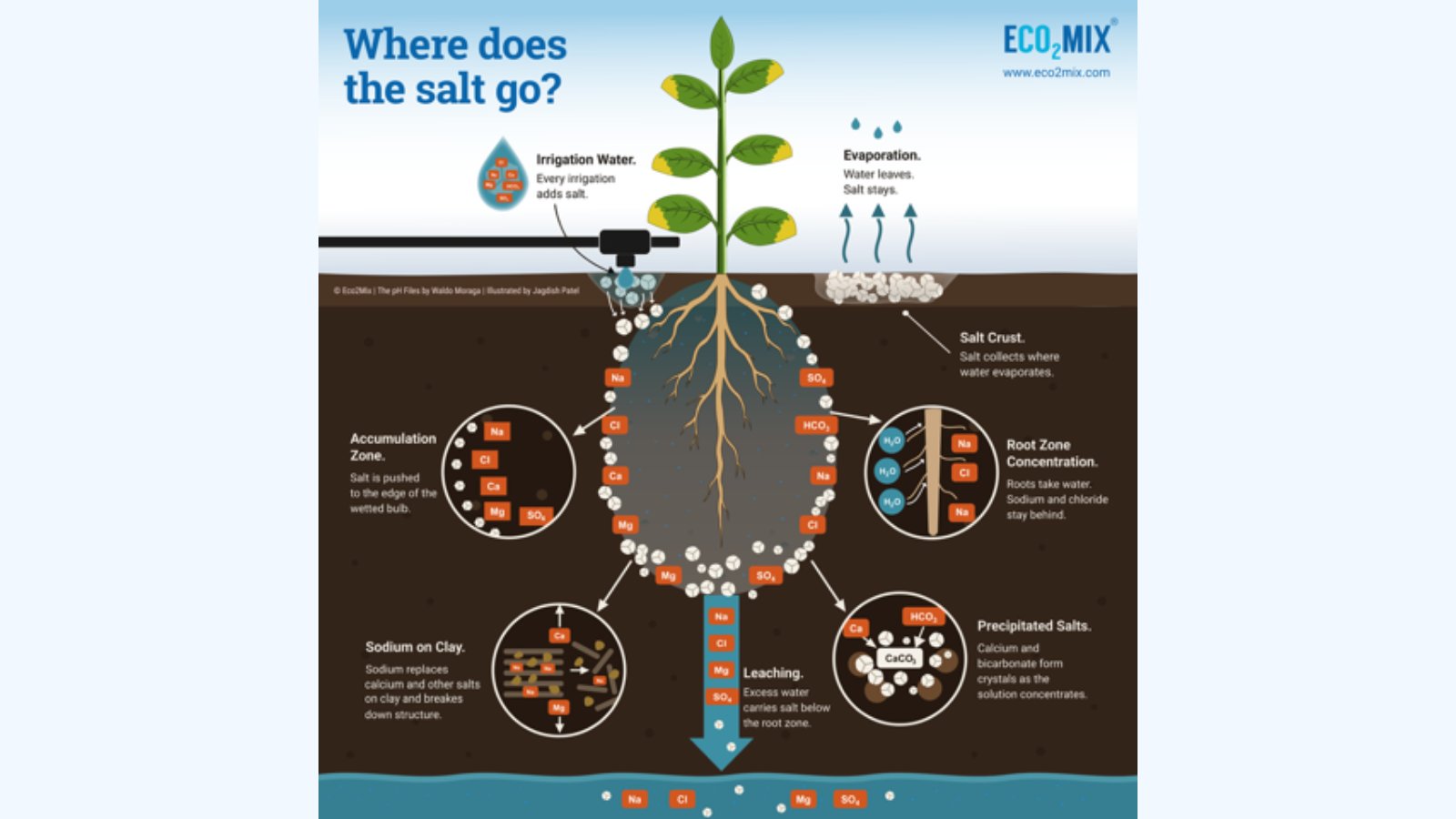
Soil lime is one source of bicarbonate. The irrigation water can be another. Fichtner and Elkins point out that when the water itself is high in bicarbonate, the risk of iron deficiency rises, because fresh bicarbonate is delivered with every irrigation. As that water evaporates, lime can crust on and around the roots.
That is the same chemistry behind the white scale covered in our article on where the salt goes under drip irrigation: as the soil solution concentrates, bicarbonate and calcium come out together as calcium carbonate.
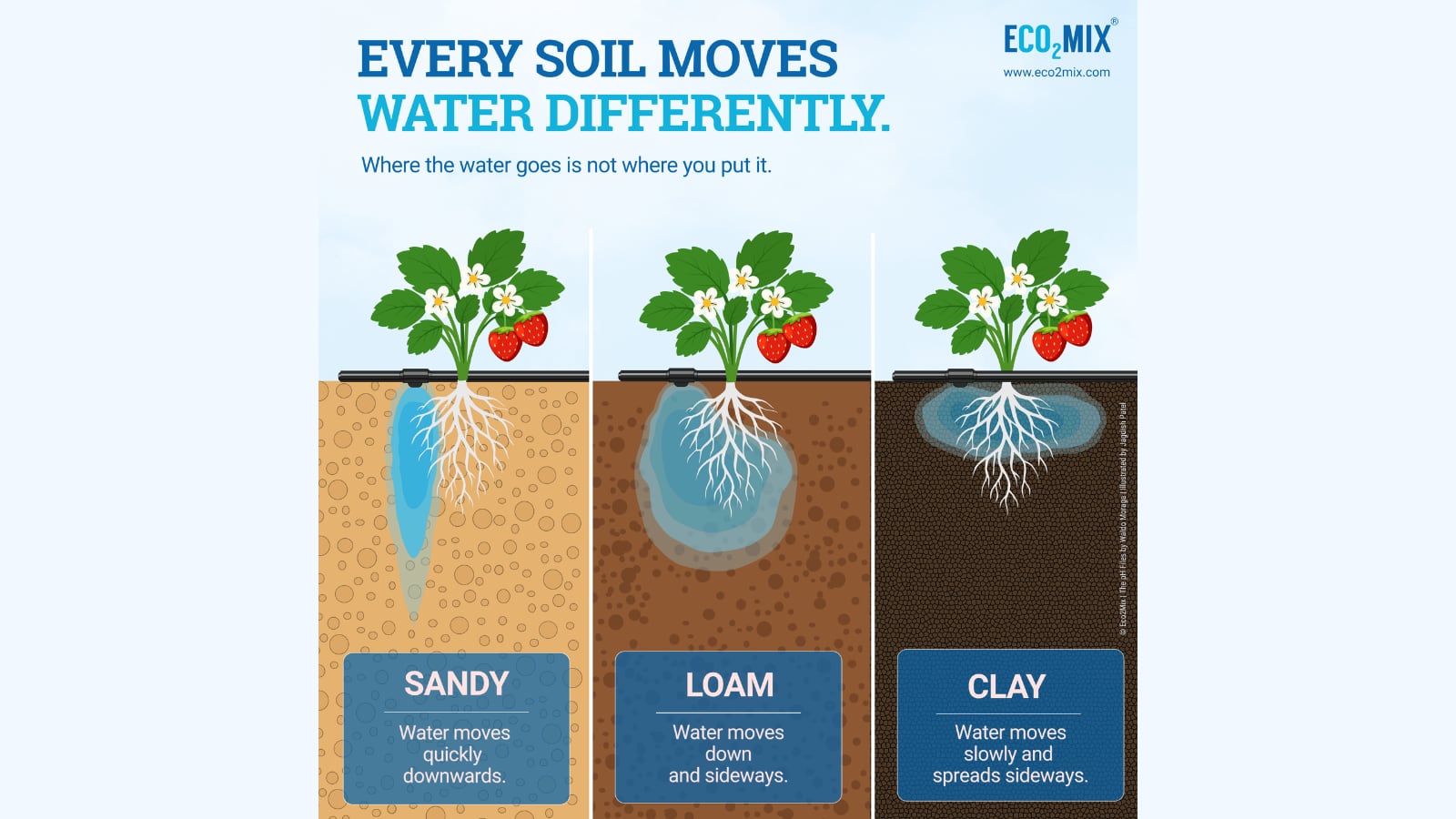
Under drip, that water goes to one place, the wetted zone around each emitter. That is also where the feeding roots are concentrated. In a permanent crop, the same roots meet the same water in the same soil for twenty years or more.
What can change and what cannot
The lime in a calcareous soil is not going anywhere. Colorado State notes that lowering soil pH is impractical when the soil contains free lime, and that hard irrigation water works against any acidifying treatment put on the soil. UC’s Fruit Report adds that neutralizing all the bicarbonate in a root zone would take a prohibitive amount of material, but that acidifying even a portion of the root zone can help.
A grower inherits the soil. The water chemistry is the part that can change.
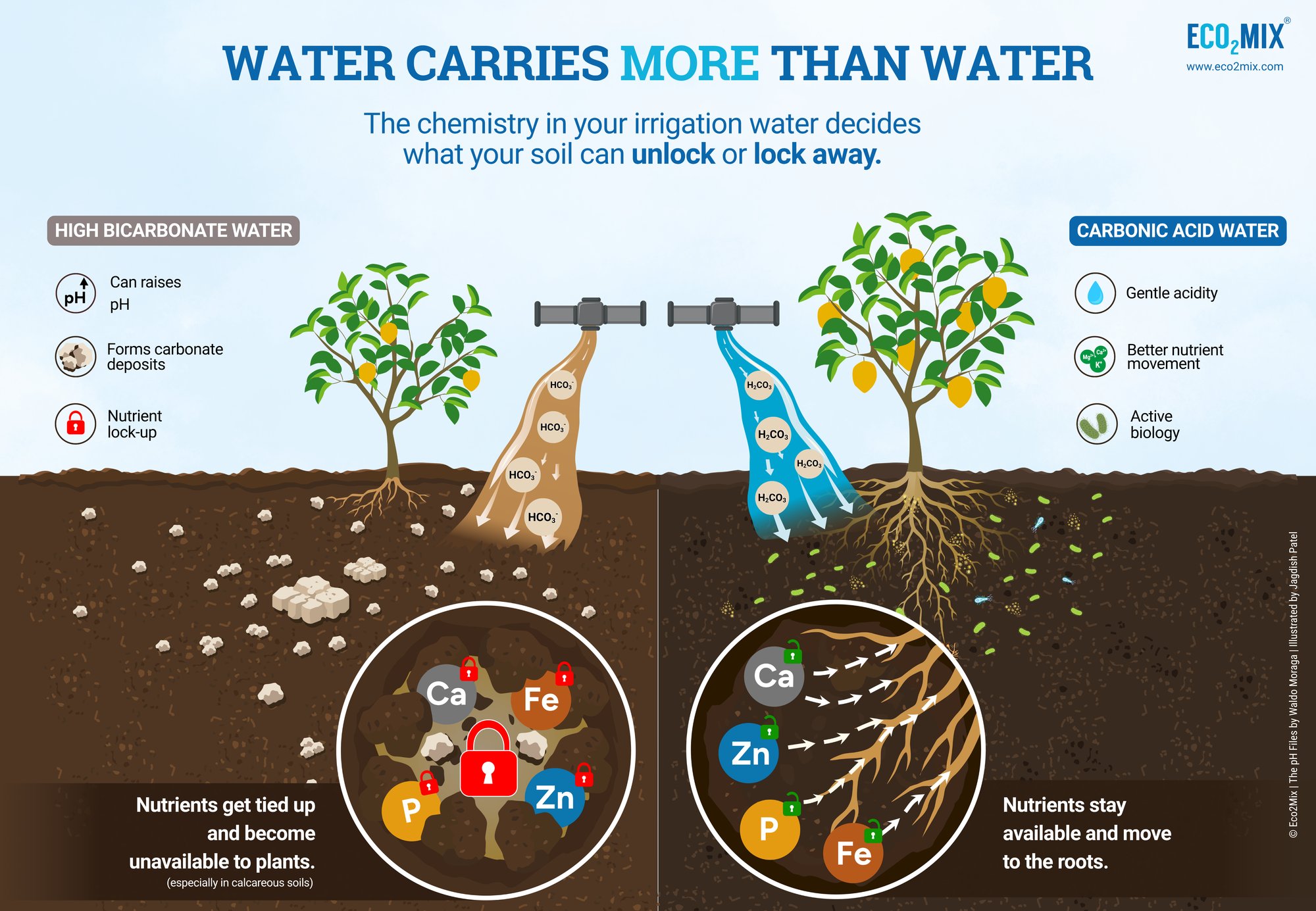
The illustration puts the two waters side by side. On the left, bicarbonate keeps the soil around the root alkaline, and iron, zinc and phosphorus stay tied up. On the right, the water carries carbonic acid instead, so less bicarbonate reaches the root and the root’s own acid has a chance to do its work.
ECO2MIX works on that part. It dissolves carbon dioxide into the irrigation water, where it forms carbonic acid and converts part of the bicarbonate before the water reaches the root. Carbon dioxide adds no ion, so nothing is left behind in the soil. The pH effect it has in the soil is brief and local to the wetted zone, which is the soil where the feeding roots take up iron. It does not remove the lime, and it does not add iron. It lowers the bicarbonate load the water brings to the root.
A pot trial on grapevines points the same way. Lampreave and colleagues (2022) irrigated Tempranillo with carbonated water on three calcareous soils and recorded higher chlorophyll levels, along with better growth and yield.
The iron was never missing. The root needed its acid to reach it.
Quick answers on iron deficiency chlorosis
Why are my trees yellow when the soil test shows enough iron?
The iron is there, but not in a form the roots can take up. In calcareous soil, bicarbonate holds the soil around the root at a high pH, and at that pH iron stays locked in solid iron oxides.
What does iron deficiency chlorosis look like?
Yellow leaves with green veins on the newest growth at the shoot tips, while older leaves stay green. Iron does not move from old leaves to new ones. Severe cases bring white leaves, sunburned tissue, shoot dieback and a smaller crop.
Can a leaf test confirm iron deficiency?
Not reliably on calcareous soil. A yellow leaf can test the same as a green one for total iron, or even higher, so a normal number does not rule iron chlorosis out.
Why doesn’t iron fertilizer fix chlorosis?
Iron added to calcareous soil turns into the same insoluble forms that were already there. Chelates and foliar sprays can green leaves, but the response is often patchy and short-lived, because the bicarbonate that caused the problem has not gone anywhere.
References
Card, A., Whiting, D., Reeder, J., and Wilson, C. 2015, reviewed 2023. Iron chlorosis of woody plants. CMG GardenNotes #223, Colorado State University Extension.
Fichtner, E., and Elkins, R. Lime-induced iron chlorosis: a nutritional challenge in the culture of several subtropical perennial crops in California. Topics in Subtropics, University of California Agriculture and Natural Resources.
Lampreave, M., Mateos, A., Valls, J., Nadal, M., and Sánchez-Ortiz, A. 2022. Carbonated irrigation assessment of grapevine growth, nutrient absorption, and sugar accumulation in a Tempranillo (Vitis vinifera L.) vineyard. Agriculture 12(6): 792.
Lucena, C., Romera, F.J., Rojas, C.L., García, M.J., Alcántara, E., and Pérez-Vicente, R. 2007. Bicarbonate blocks the expression of several genes involved in the physiological responses to Fe deficiency of Strategy I plants. Functional Plant Biology 34(11): 1002-1009.
Mengel, K. 1994. Iron availability in plant tissues: iron chlorosis on calcareous soils. Plant and Soil 165: 275-283.
Römheld, V. 2000. The chlorosis paradox: Fe inactivation as a secondary event in chlorotic leaves of grapevine. Journal of Plant Nutrition 23(11-12): 1629-1643.
Sahrawat, K.L. 2016. Soil and plant testing for iron: an appraisal. Communications in Soil Science and Plant Analysis 47(3): 280-283.
University of California Agriculture and Natural Resources. Iron (Fe). The Fruit Report.
This article is part of The pH Files series from ECO2MIX. Written and illustrated by Jagdish Patel, Soil Stories (jagdishpatel.info).

Was this article helpful?
Thanks for your feedback!
Better Water pH for Your Crops
Get a Proposal