On This Page
Why does a crop run short of phosphorus when the soil test says there is plenty? Many growers have seen it. The lab report looks fine, the fertilizer has gone on, and the crop still looks hungry.
Part of the answer is that roots do not go looking for most of what they eat. Working with corn, the soil scientist Stanley Barber estimated that only about one percent of the nutrients a plant takes up come from roots growing straight into them. Everything else has to travel to the root.
That trip is a few millimeters long, and it decides more than most fertilizer programs plan for. Often the phosphorus is in the field. It is just not reaching the root.
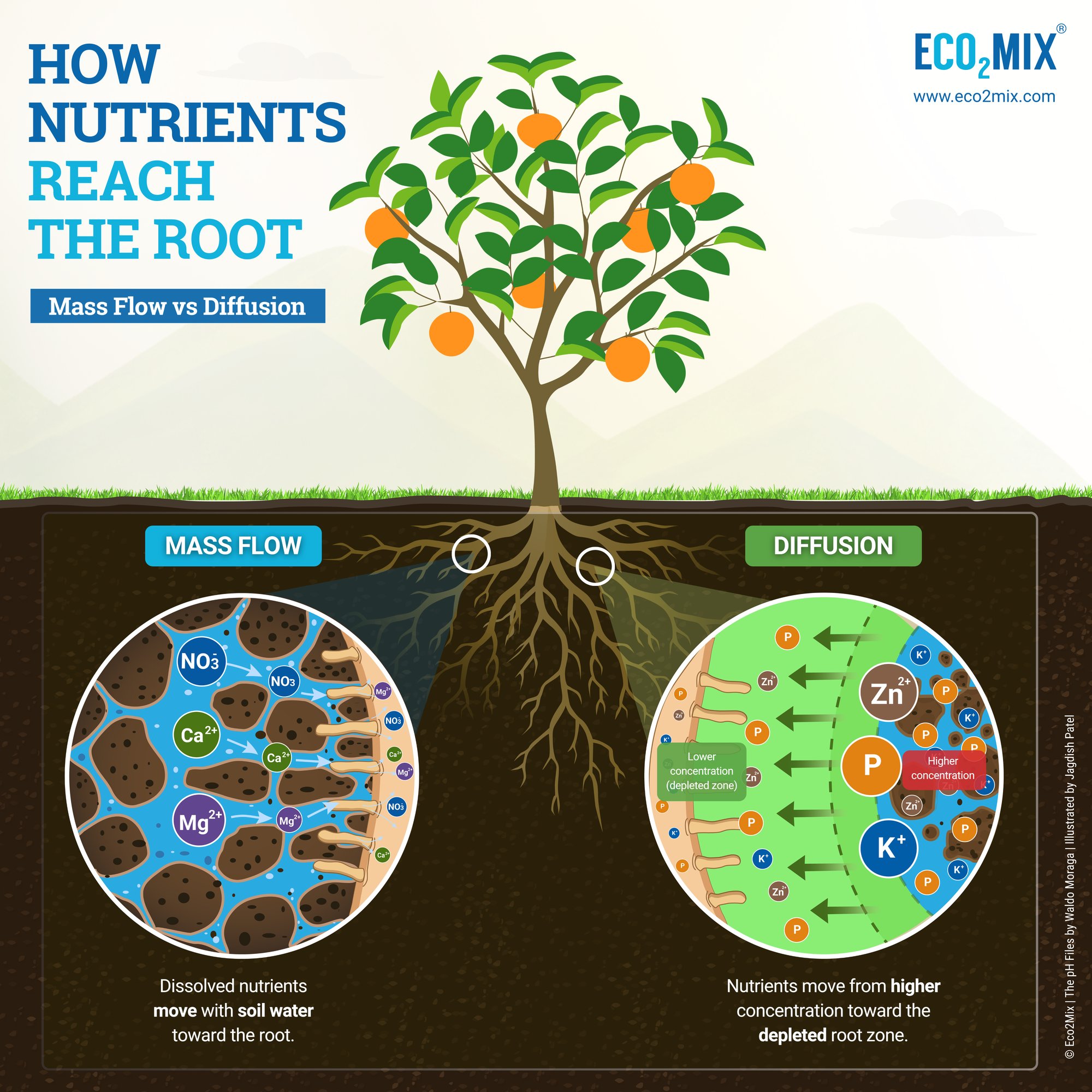
Nutrients make the trip by two main routes: mass flow and diffusion. In mass flow, they ride along with water moving toward the root. In diffusion, they move on their own, from where there is more of them to where there is less. This article follows both routes and shows why each one stops when a nutrient has not dissolved. Quick answers to common questions are at the end.
Three ways nutrients reach plant roots
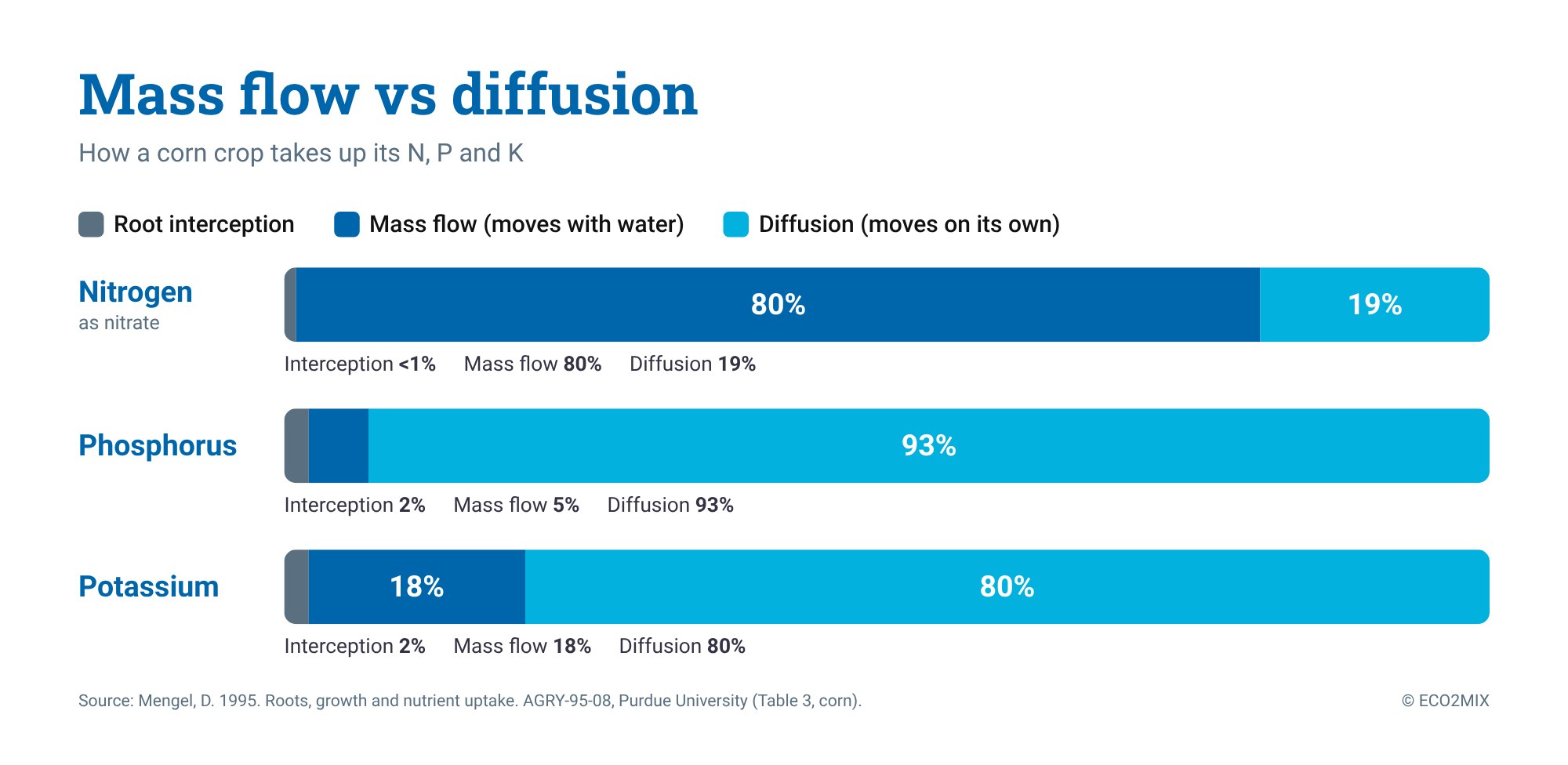
A growing root does pick up some nutrients just by pushing into them. This is called root interception. In the corn figures Dave Mengel summarizes for Purdue University, it supplies under 1 percent of the nitrogen and about 2 percent of the phosphorus and potassium the crop takes up.
The rest has to come to the root through the soil solution, the thin films of water held around soil particles. What carries it there depends on the nutrient.
What is mass flow in plants?
Every time a leaf loses water, the plant pulls more in through its roots. Soil water moves toward the root to replace it, and whatever is dissolved in that water moves too. That is mass flow.
The nutrients that arrive this way are the ones that stay dissolved in large amounts and are not held tightly by soil particles. Purdue lists nitrate, calcium and sulfur as the nutrients normally supplied by mass flow. In the corn figures, mass flow can deliver about 80 percent of the nitrogen the crop takes up.
Because mass flow runs on transpiration, the more water a crop uses, the more dissolved nutrient that water brings to its roots.
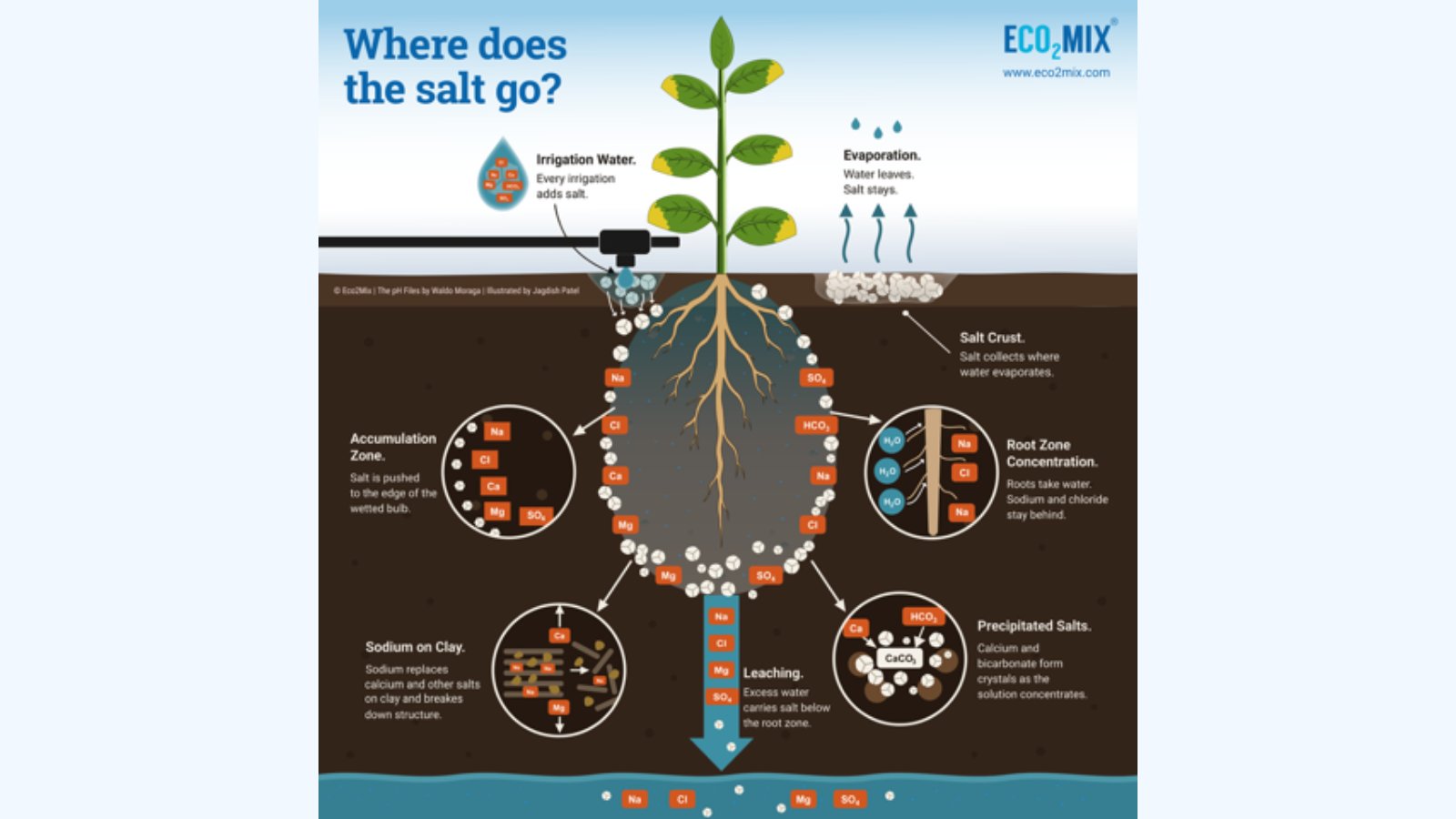
Mass flow can also bring more than a plant wants. Roots take up only what they need, so an ion in large supply, such as calcium or sulfate, can build up at the root surface. Mengel notes that in perennial crops this can leave visible coatings of calcium carbonate and calcium sulfate on older roots. The same thing happens anywhere water leaves and dissolved salts stay behind, which is why salt gathers at the outer edge of the wetted soil, as covered in our article on where the salt goes under drip irrigation.
What is diffusion in soil?
Phosphorus and potassium work differently. Soil particles hold them tightly, so only small amounts are dissolved at any moment, and mass flow brings very little of either. In the corn figures, it supplies about 5 percent of the phosphorus.
The root creates its own pull instead. As it takes up phosphorus from the solution right next to it, the concentration there drops below the soil a little farther out. Phosphorus then moves from where there is more to where there is less, the way a drop of food coloring spreads through still water with nothing stirring it. That movement is diffusion. The drawn-down shell of soil around the root is called the depletion zone.
Diffusion carries most of the phosphorus, potassium and zinc that reach a root. In Purdue’s corn figures, that is about 93 percent of the phosphorus and 80 percent of the potassium.
It is also slow, and it works over very short distances. Once the soil next to a root is drawn down, the root depends on phosphorus moving in from slightly farther away, or on growing into fresh soil. A root held back by compaction, cold or waterlogged soil stops reaching new phosphorus.
Many crops get extra reach from mycorrhizal fungi. Their threads run centimeters past the root surface, into soil the root has not reached, and trade phosphorus back to the plant for carbon. Soil Stories has a full explainer on how fungi trade nutrients with plant roots.
How soil moisture affects nutrient uptake
Mass flow needs water moving toward the root. Diffusion needs water too, because ions can only diffuse through the soil solution. As soil dries, that solution shrinks to thin, broken films around particles, and the path an ion has to take gets longer and more twisted.
Kuchenbuch, Claassen and Jungk (1986) measured this for potassium. Raising soil water content from 10 to 40 percent by volume made potassium about ten times more mobile in the soil. The potassium content of their onion plants rose with soil moisture, and root growth fell off in the driest soil.
Mengel reports the same thing from the field: in dry years, crops generally carry less of their nutrients than in normal or wet years.
Some deep-rooted plants move water on their own. At night, roots can carry water up from moist subsoil into dry topsoil, a process covered in hydraulic lift: how deep roots rewet dry topsoil at night. It shifts water around without adding any, and most of the evidence comes from perennials and shrubs.
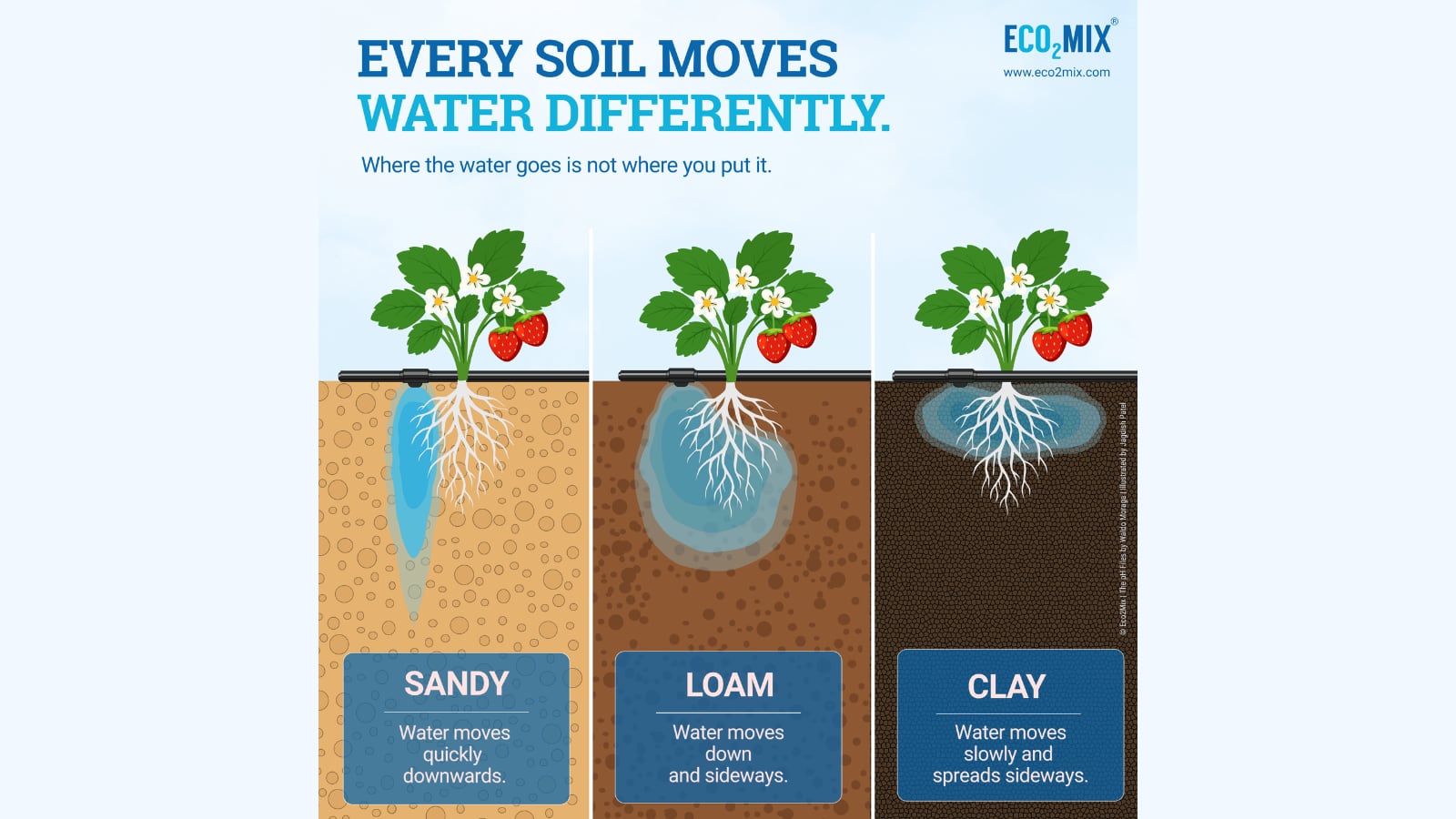
Under drip, both routes run inside the soil each emitter wets, which takes a different shape in sand, loam and clay. Outside that volume, the soil may still test well for nutrients, but there is little water to carry them.
Soil pH and nutrient availability
Mass flow and diffusion have one thing in common. Both move nutrients through water, so a nutrient has to be dissolved before either can carry it. Penn and Camberato (2019) open their review of soil phosphorus with the same point: a nutrient has to dissolve before a plant can use it.
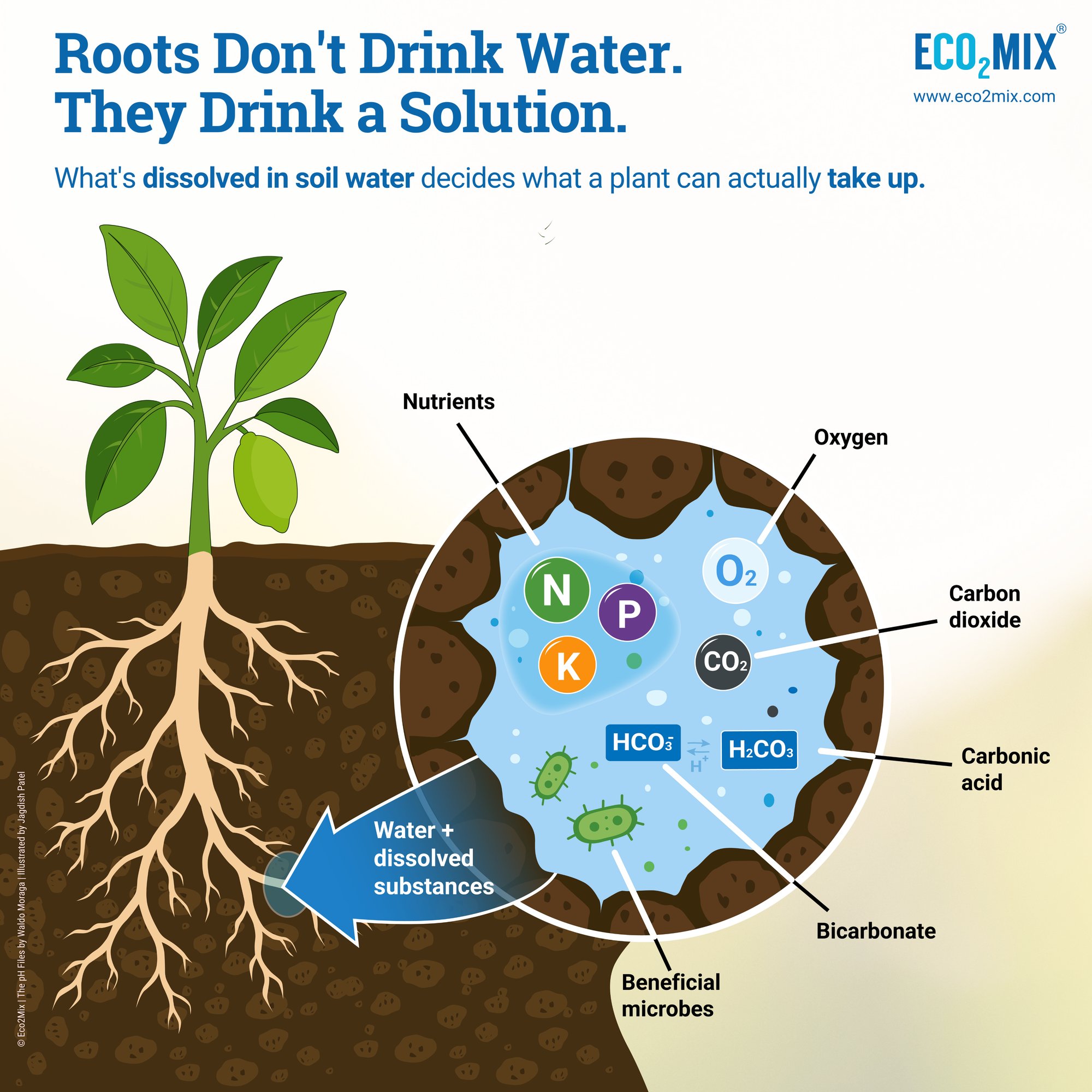
The illustration shows what a root drinks: the soil solution, a thin film around soil particles that carries dissolved nutrients and dissolved carbon. The chemistry of that film sets its pH, and only what is dissolved in it can reach the root by either route.
Soil pH decides how much dissolves. In that review, calcium phosphates form more readily as pH and dissolved calcium rise, which takes phosphorus out of solution. The authors also back the long-standing view that phosphorus is most available near pH 6.5. In a calcareous soil, free lime keeps both the pH and the calcium high.
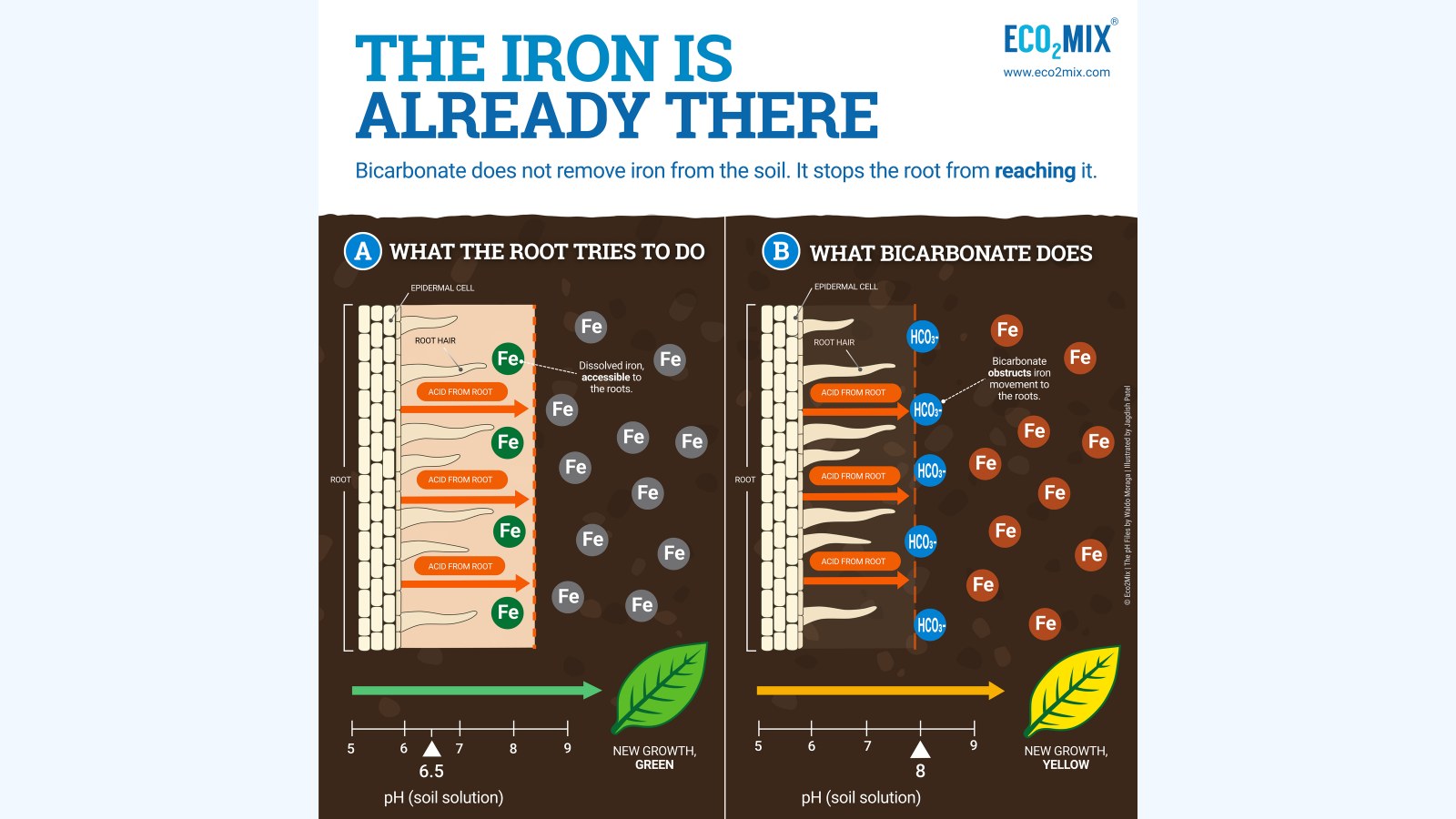
Zinc behaves the same way. Alloway (2009) lists high pH, high calcite and high bicarbonate in the soil solution among the main soil factors that limit zinc to plants. Iron is the extreme case. Fichtner and Elkins, writing for UC Cooperative Extension, note that iron solubility changes about a thousandfold for every one unit change in pH, which is the story behind our article on iron deficiency chlorosis.
This is why a soil test and a crop can disagree. A soil test measures what a lab extractant pulls out of a sample. The root can only take what is dissolved in the few millimeters around it, and only when there is water to bring it there.
How irrigation water changes nutrient uptake
In the wetted zone, irrigation water becomes the soil solution, the same water both routes run through, and it brings its own chemistry. Water high in bicarbonate delivers fresh alkalinity with every irrigation, to the soil where the feeding roots are.
ECO2MIX works on the water. It dissolves carbon dioxide into the irrigation water, where it forms carbonic acid and converts part of the bicarbonate before the water reaches the root. Carbonic acid lowers pH in the wetted root zone, the soil solution that both routes draw from. Carbon dioxide adds no ion of its own, so nothing from it builds up in the soil. ECO2MIX adds no nutrients of its own. It changes the water that carries them.
For a grower, the place to start is the water report. Its pH and bicarbonate figures show how much alkalinity each irrigation carries into the root zone. ECO2MIX runs as a fully managed service: the system dissolves carbon dioxide into the line as water is pumped, and its team keeps that water on its target pH. Every irrigation then reaches the roots carrying less bicarbonate, and because nutrients travel in that water, the change reaches mass flow and diffusion at the same time.
Fertilizer gets a nutrient into the field. The last few millimeters are up to the water.
Mass flow vs diffusion: quick answers
What is the difference between mass flow and diffusion?
Mass flow moves nutrients along with water as the plant pulls water toward its roots. Diffusion moves nutrients from higher to lower concentration, into the depleted soil around a root, whether or not the water itself is moving.
Which nutrients move by mass flow and which by diffusion?
Nitrate, calcium and sulfate reach roots mostly by mass flow. Phosphorus, potassium and zinc reach them mostly by diffusion. Root interception, where a root grows into a nutrient, supplies only a small share of most nutrients.
Why can a soil test show enough phosphorus while the crop is short?
The test measures phosphorus a lab extractant can remove. The root can only take phosphorus dissolved in the soil solution next to it. At high pH, especially in calcareous soil, much of the phosphorus is held as calcium phosphate, which neither route can move.
Does soil moisture affect nutrient uptake?
Yes. Mass flow depends on water moving toward the root, and diffusion slows sharply as soil dries, because the water films that ions move through thin out and break up. Root growth into fresh soil also slows in very dry soil.
References
Alloway, B.J. 2009. Soil factors associated with zinc deficiency in crops and humans. Environmental Geochemistry and Health 31(5): 537-548.
Fichtner, E., and Elkins, R. Lime-induced iron chlorosis: a nutritional challenge in the culture of several subtropical perennial crops in California. Topics in Subtropics, University of California Agriculture and Natural Resources.
Kuchenbuch, R., Claassen, N., and Jungk, A. 1986. Potassium availability in relation to soil moisture. I. Effect of soil moisture on potassium diffusion, root growth and potassium uptake of onion plants. Plant and Soil 95: 221-231.
Mengel, D. 1995. Roots, growth and nutrient uptake. AGRY-95-08, Department of Agronomy, Purdue University.
Penn, C.J., and Camberato, J.J. 2019. A critical review on soil chemical processes that control how soil pH affects phosphorus availability to plants. Agriculture 9(6): 120.
This article is part of The pH Files series from ECO2MIX. Written and illustrated by Jagdish Patel, Soil Stories (jagdishpatel.info).

Was this article helpful?
Thanks for your feedback!
Better Water pH for Your Crops
Get a Proposal