On This Page
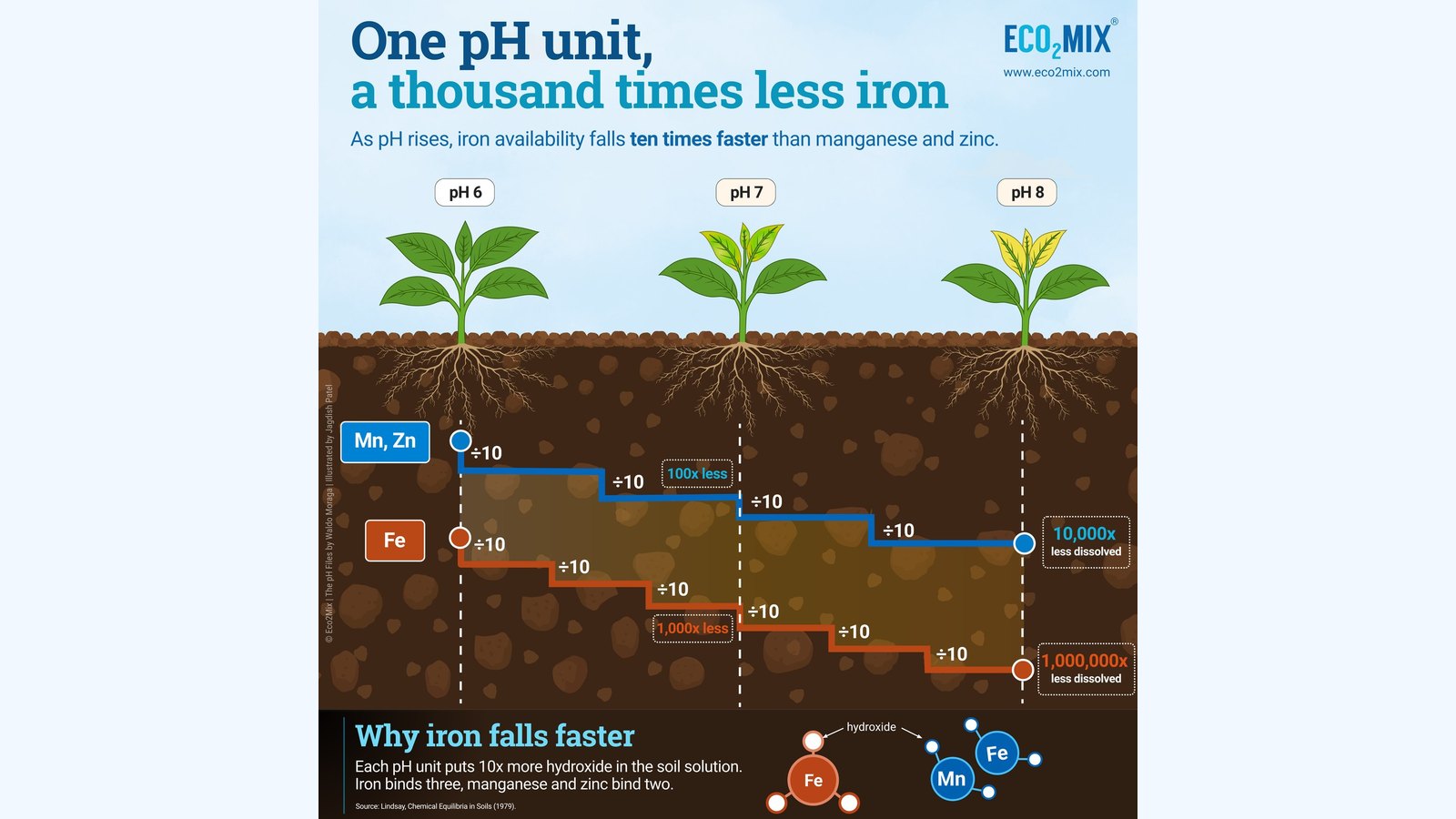
How far apart are pH 6 and pH 8? On a meter, two units. For the iron dissolved in the soil water around a root, a millionfold.
Manganese and zinc fall about ten-thousandfold over the same two units. That is why growers on high-pH ground so often see all three run short together, even when the soil test shows plenty of each. Iron usually shows first, as yellow leaves with green veins on the newest growth. Zinc and manganese turn up on the same blocks, most often on calcareous soil, where free lime and bicarbonate hold the pH up. A spray can green the leaves for a while. The next flush still grows into the same soil water.
The nutrients have not left the field. The water has stopped holding them, and that is what soil pH and micronutrient availability comes down to.
How does soil pH affect micronutrient availability?
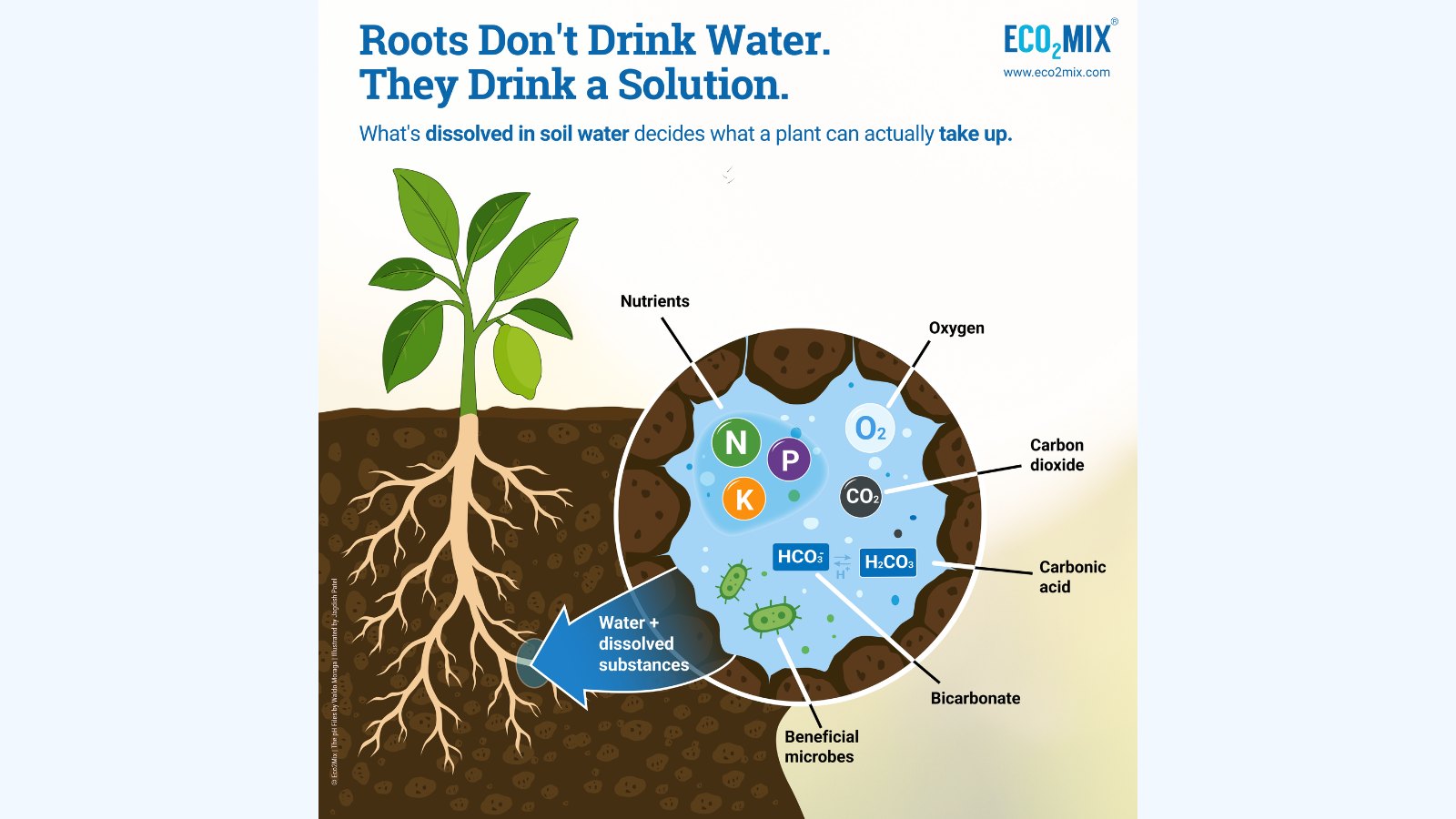
Roots take up iron, manganese and zinc from the soil solution, the thin films of water around soil particles. A nutrient locked in a solid mineral is still in the field, but it is not in that water.
pH decides how much of each one stays dissolved. Every one unit rise in pH means ten times more hydroxide ions in the soil solution, and hydroxide pulls these metals out of the water into solid forms.
Charge sets how hard that pull is. Ferric iron carries three positive charges and binds three hydroxide ions as it comes out of solution, so each pH unit counts three times: 10 x 10 x 10, a thousandfold. Zinc carries two charges and binds two, so each unit counts twice: 10 x 10, a hundredfold. Manganese falls at the same hundredfold rate.
That is why the drop is so steep. Two pH units take iron down a millionfold and manganese and zinc down ten-thousandfold.
A soil test does not see this. It reports what a lab extractant can pull from a sample, including nutrients held on soil particles. The root only gets what is dissolved, a difference Soil Stories covers in its explainer on EC and CEC in soil.
Iron availability and soil pH
Most soils hold plenty of iron as iron oxides, the minerals that give soil its red and brown colors. Very little of it dissolves. Fichtner and Elkins, writing for UC Cooperative Extension, put the pH effect plainly: the solubility of ferric iron rises a thousandfold for every one unit drop in pH.
Run that the other way and iron is the first of the three to disappear. At pH 7, a root is already working with a thousandth of the dissolved iron it had at pH 6. At pH 8, it is a millionth.
The result shows on new growth first, as yellow leaves with green veins, because iron does not move from old leaves to new ones. Our article on iron deficiency chlorosis follows that problem from the soil to the leaf, including why soil and leaf tests often miss it.
Manganese and zinc deficiency in high pH soil
Manganese and zinc fall more slowly than iron, but they still fall fast.
Schulte and Kelling, in a University of Wisconsin Extension guide, give the manganese figure directly: the amount of manganese in solution drops 100-fold for each unit rise in soil pH, as from 5.0 to 6.0. They flag soils above pH 6.5 that are also high in organic matter as the ones most likely to run short.
Manganese also responds to oxygen. In wet, poorly aerated soil, manganese oxide converts to soluble Mn²⁺, so availability can climb after heavy irrigation or rain. Under prolonged waterlogging, that soluble manganese can leach away. The same block can swing between short and well supplied on soil moisture alone.
Zinc follows the same hundredfold slope. In Zinc in Soils and Crop Nutrition, Alloway (2008) shows dissolved zinc at about 10⁻⁴ M at pH 5 and about 10⁻¹⁰ M at pH 8, a millionfold drop across three units. He also lists high bicarbonate and high phosphorus among the soil conditions that reduce zinc availability, and rates citrus, grapes, pecans, beans and maize among the crops most sensitive to zinc deficiency.
Alloway (2009) narrows it further: high pH, high calcite and high bicarbonate in the soil solution are among the main soil factors behind zinc deficiency in crops. That is a description of a calcareous soil, which is where iron runs short too.
How roots get micronutrients in calcareous soil
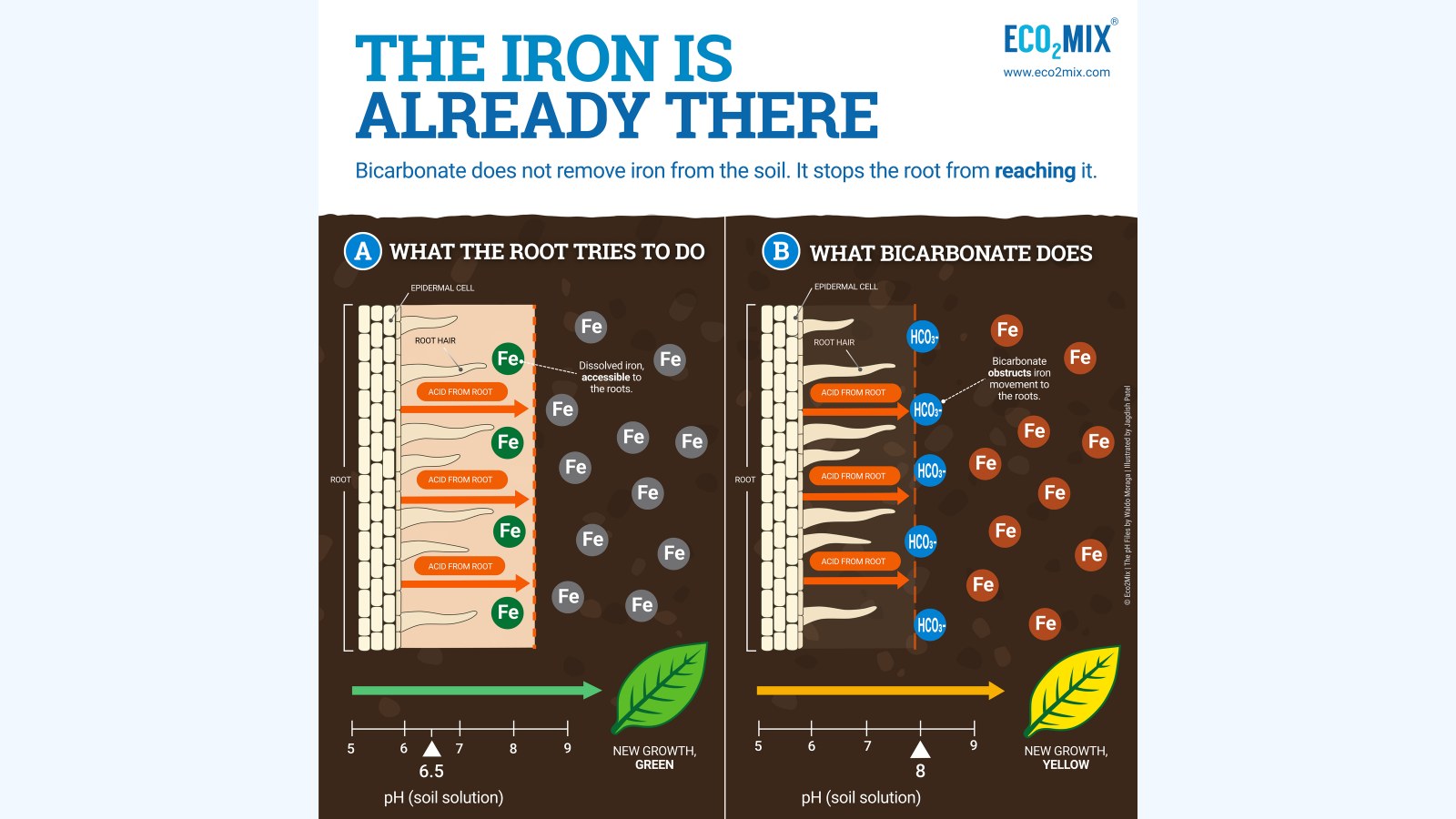
Roots do fight back. Most crops release protons at the root surface to acidify the soil right around them, which dissolves some of the iron the bulk soil holds. Grasses take another route. Alloway (2008) describes how they release compounds called phytosiderophores when short of iron or zinc, and these can hold zinc, copper and manganese in solution as well as iron. Plants also release other compounds from their roots under iron stress, which Soil Stories covers in how root exudates and microbes support plant resilience.
On a calcareous soil, the root is pushing against a buffer. Free lime keeps bicarbonate in the soil water, and bicarbonate neutralizes the acid the root releases. Fichtner and Elkins point out that when the irrigation water is also high in bicarbonate, the risk of iron deficiency rises, because fresh bicarbonate arrives with every irrigation.
Distance matters too. Alloway (2008) notes that zinc reaches the root mainly by diffusion, moving through the soil water from where there is more of it to where there is less. When very little zinc is dissolved, very little can move, a point covered in our article on mass flow and diffusion.
How irrigation water affects micronutrient availability
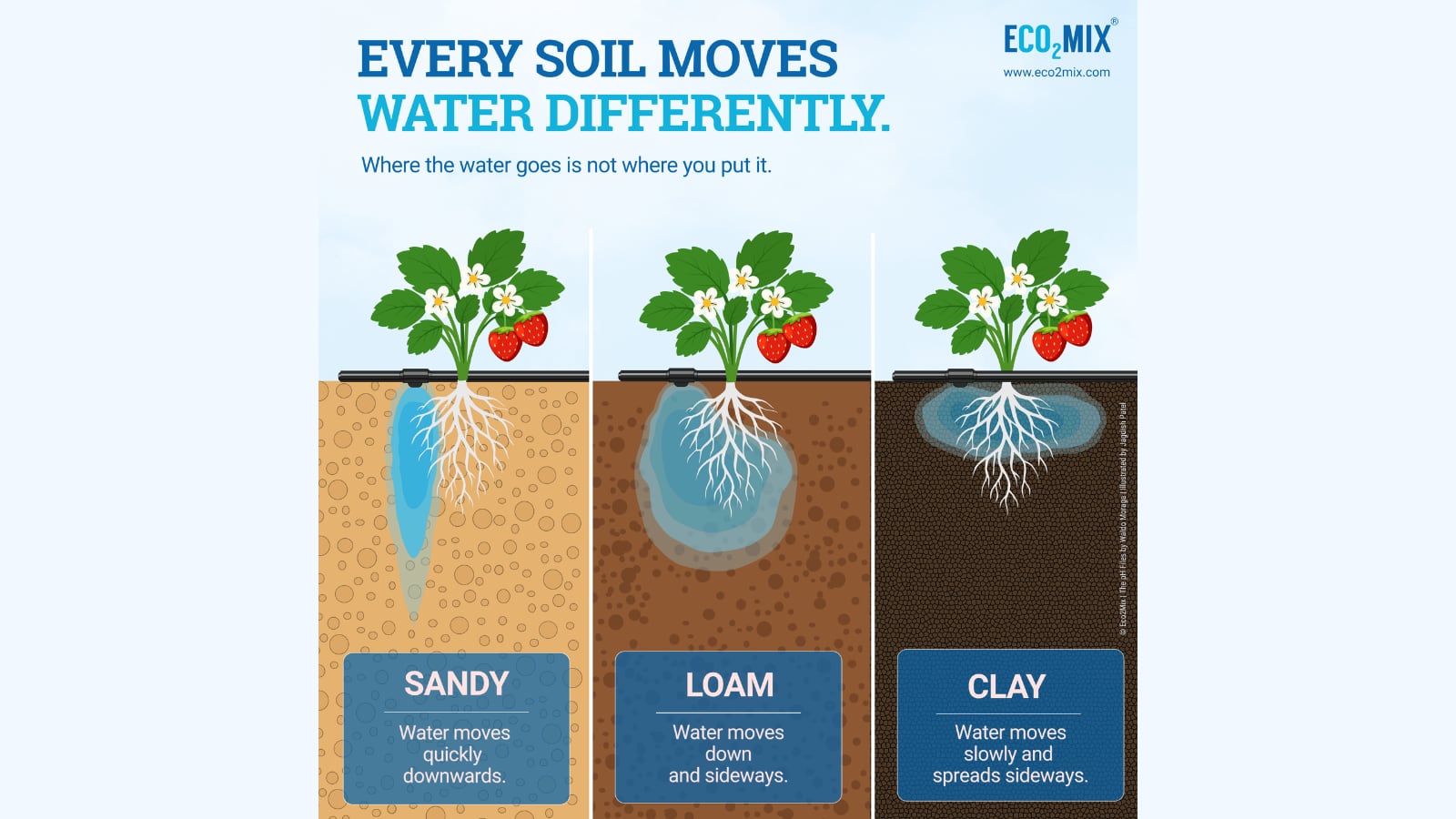
In the wetted zone under each emitter, irrigation water becomes the soil solution the feeding roots draw from, and its chemistry becomes the root zone’s chemistry.
ECO2MIX works at that point. It dissolves carbon dioxide into the irrigation water, where it forms carbonic acid and converts part of the bicarbonate before the water reaches the root. Carbonic acid lowers pH in the wetted root zone. Carbon dioxide adds no ion of its own, so nothing from it builds up in the soil. It does not add iron, manganese or zinc. It changes how much of what is already there the water can hold.
Because the scale is logarithmic, any drop in pH works on all three at once, in the same wetted soil where the feeding roots are.
A pot trial on grapevines points the same way. Lampreave and colleagues (2022) irrigated potted Tempranillo with carbonated water on three soils with different amounts of active lime, and recorded higher chlorophyll levels, along with better growth and yield. It was a pot trial, not a field trial. We summarize it in carbonated irrigation in a Tempranillo vineyard.
For a grower looking at this for the first time, the water report is the place to start. Its pH and bicarbonate figures show how much alkalinity every irrigation carries into the root zone, and how far that water is from where these three nutrients stay dissolved. On a pH meter, pH 6 and pH 8 are two units apart. In the soil solution, for iron, they are six zeros apart.
Soil pH and micronutrients: quick answers
Which micronutrients does high soil pH affect most?
Iron, manganese and zinc. All three become far less soluble as pH rises, and iron falls fastest: about a thousandfold per pH unit, against about a hundredfold for manganese and zinc.
Why does iron drop faster than manganese and zinc?
Charge. Ferric iron carries three positive charges and binds three hydroxide ions as it leaves the soil solution, so each tenfold rise in hydroxide counts three times. Zinc carries two charges and binds two, so it counts twice.
Can waterlogging change manganese availability?
Yes. In wet, poorly aerated soil, manganese oxide converts to soluble manganese, so availability can rise. Under prolonged waterlogging, that soluble manganese can leach out of the root zone.
Why can a soil test show enough zinc or iron while the crop runs short?
A soil test measures what a lab extractant pulls out of a sample. At high pH, very little of that is dissolved in the soil water, and roots can only take up what is dissolved.
How can carbonic acid in irrigation water help iron, manganese and zinc in high pH soil?
ECO2MIX dissolves carbon dioxide into the irrigation water, where it forms carbonic acid and lowers pH in the wetted root zone, the soil where feeding roots take up these nutrients. Because all three become more soluble as pH falls, a lower pH in that soil works on iron, manganese and zinc at the same time. It does not add any of them. It acts on what is already in the soil.
Does ECO2MIX leave anything behind in the soil?
No. Carbon dioxide forms carbonic acid in the water and adds no ion of its own, so nothing from it builds up in the soil. The dose is set to the pH each crop needs, with no concentrated acid to store or handle on the farm.
References
Alloway, B.J. 2008. Zinc in Soils and Crop Nutrition. Second edition. International Zinc Association and International Fertilizer Industry Association, Brussels and Paris.
Alloway, B.J. 2009. Soil factors associated with zinc deficiency in crops and humans. Environmental Geochemistry and Health 31(5): 537-548.
Fichtner, E., and Elkins, R. Lime-induced iron chlorosis: a nutritional challenge in the culture of several subtropical perennial crops in California. Topics in Subtropics, University of California Agriculture and Natural Resources.
Lampreave, M., Mateos, A., Valls, J., Nadal, M., and Sánchez-Ortiz, A. 2022. Carbonated irrigation assessment of grapevine growth, nutrient absorption, and sugar accumulation in a Tempranillo (Vitis vinifera L.) vineyard. Agriculture 12(6): 792.
Schulte, E.E., and Kelling, K.A. 1999. Understanding plant nutrients: soil and applied manganese. A2526, University of Wisconsin-Extension.
This article is part of The pH Files series from ECO2MIX. Written and illustrated by Jagdish Patel, Soil Stories (jagdishpatel.info).

Was this article helpful?
Thanks for your feedback!
Better Water pH for Your Crops
Get a Proposal